Rehearsal Documentation Template
DOCX download
Rehearsal Documentation Template
Free editable Word guide you can copy, fill in, and share with your band. Also readable on this page.
How to use this guide
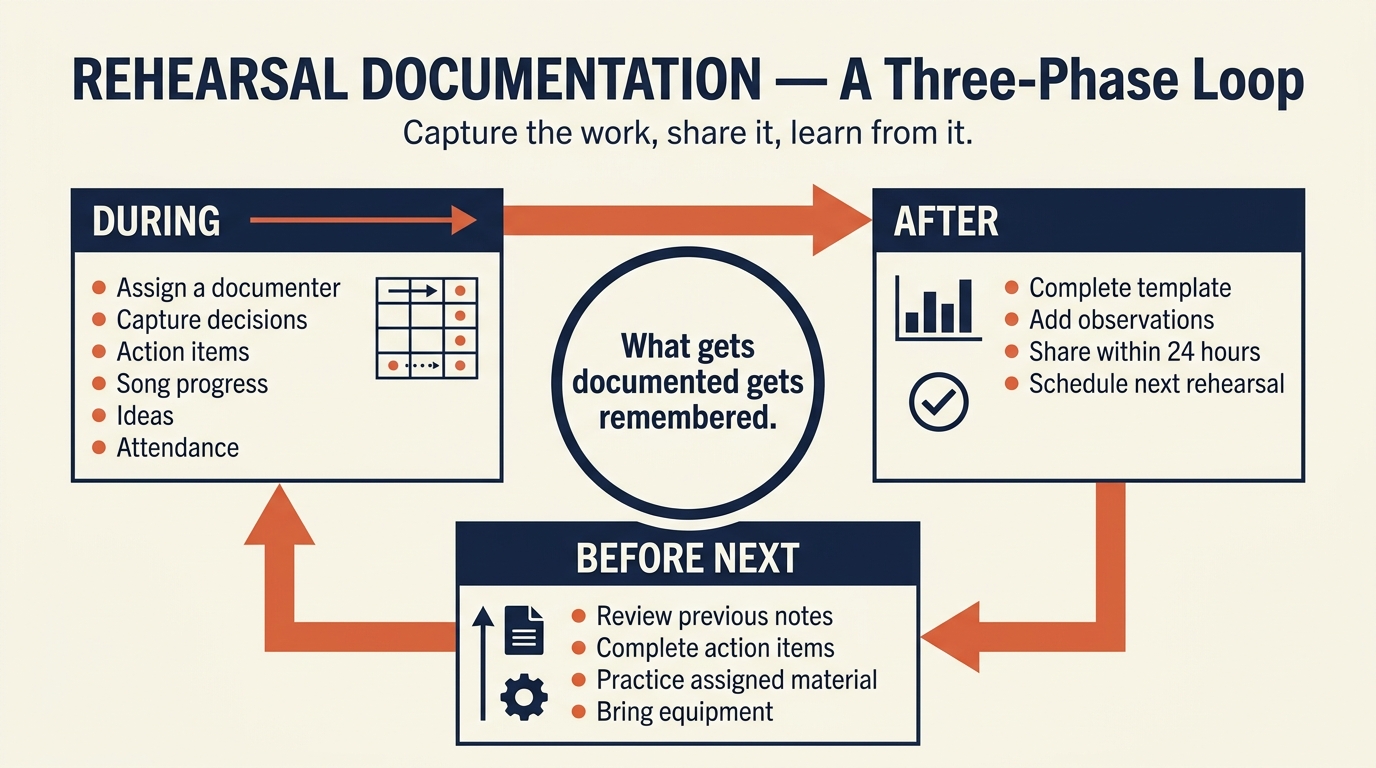
Template for documenting rehearsal outcomes. Finish with a five-line session note the whole band can find again next week.
Fill the date, present, decisions, homework, and next-focus blanks during the last five minutes of each session, keep the log beside your setlists, and reread it whenever an arrangement argument resurfaces.
What is not written gets re-argued. Light documentation compounds improvement across weeks without turning the band into a bureaucracy.
What is worth writing
A good record of a rehearsal fits in five short lines: who showed up, which songs got touched, what changed about form, key, or tempo, who owes which practice assignment, and one seed for the following agenda. Anything longer becomes a novel nobody rereads, and anything vaguer cannot settle the argument about whether the bridge was cut.
Rotate the scribe job every week or let one person own it permanently, but have them transcribe a same-night voice memo before anyone forgets. When the band keeps reopening a settled arrangement three sessions running, that is not a creativity problem; it means nobody captured the answer where it could be found again.
Where notes live
The running log belongs in one shared folder beside the setlists, charts, and rough mixes the band already opens, because a separate app nobody checks becomes a graveyard. A shared Google Doc or pinned group-chat thread both work if the drummer can find Tuesday’s tempo change without texting anyone.
Anything personal, like a warning about chronic lateness, stays in private messages rather than the shared log. Creative choices belong in the open so a member who missed Tuesday, or one dialing in from another city, arrives Thursday already knowing the new intro instead of needing a twenty-minute recap.
Use notes to start on time
The first five minutes of each session belong to reading last week’s entries aloud, so the room starts from agreed facts instead of whoever remembers loudest. A settled fight about cutting the second chorus stays settled unless someone brings genuinely new information, like the singer’s range changing after lessons.
Bands that run this way look oddly professional to sound engineers, venue bookers, and fill-in players, because answers arrive fast. The guitarist subbing in for one gig can skim three weeks of entries in the van and walk in knowing the endings, the set order, and which song still has an unresolved solo.
Fill-in: Session note template
Date: ________
Present: ________
Decisions: ________
Homework: ________
Next focus: ________
Putting it into practice
Assign a scribe for the next rehearsal and store notes where everyone can open them.
FAQ
What is worth documenting every rehearsal?
Attendance, songs touched, decisions (cuts, keys, form), homework owners, and next agenda seeds. Not a novel.
Who writes the notes?
Rotate or assign a fixed scribe. Phone voice memos work if transcribed the same night.
How does documentation improve the next session?
You stop re-arguing settled form choices and start on time with known homework. Memory is not a DAW.
Should notes be shared publicly?
Share with the band; keep personnel issues private. Creative notes can live next to setlists.