Rehearsal Agenda Template
DOCX download
Rehearsal Agenda Template
Free editable Word guide you can copy, fill in, and share with your band. Also readable on this page.
How to use this guide
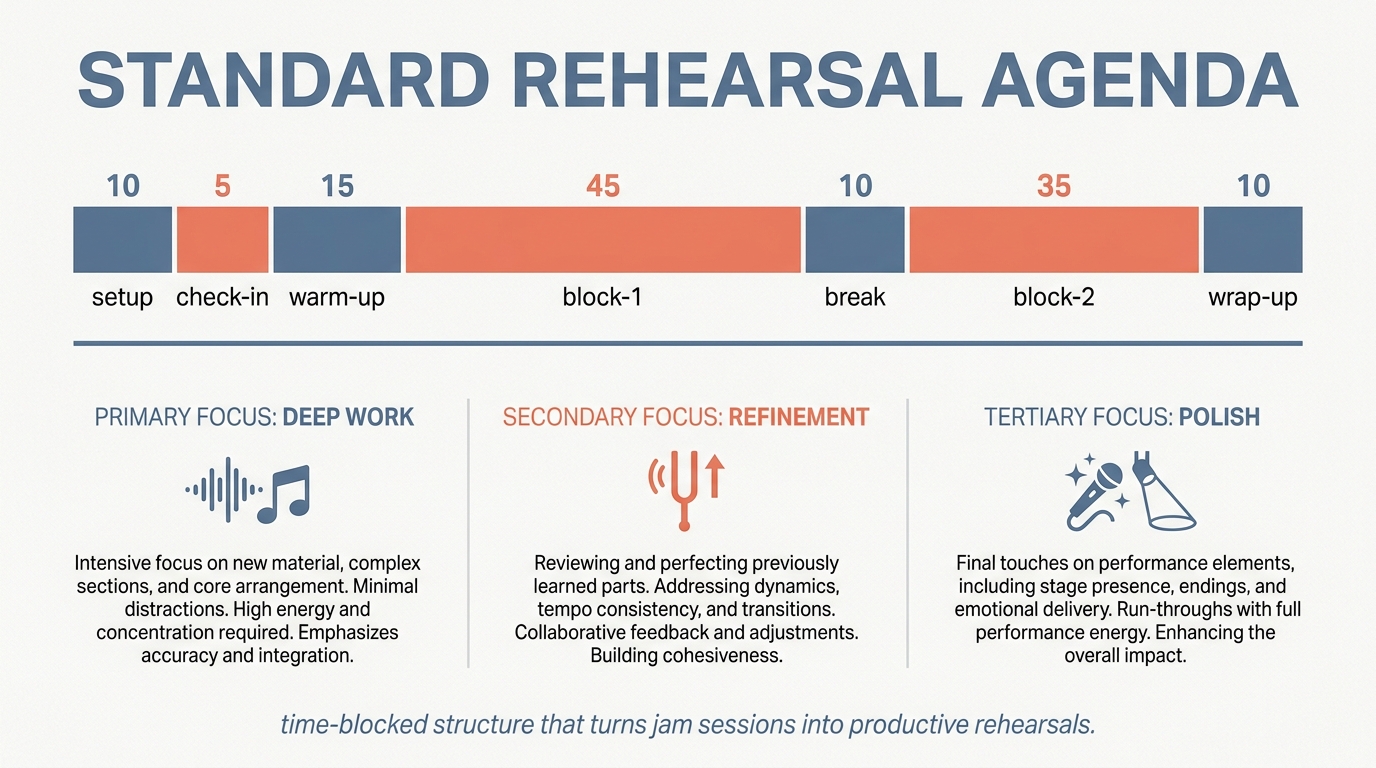
Template for planning productive rehearsals. The result is a one-page agenda with goals, song order, owners, and a hard stop.
Draft the agenda the night before from the last session's homework, fill the date, goals, songs, and hard stop, and send it to the group chat before anyone plugs in.
Rehearsals without agendas become expensive hangs. An agenda turns rent money into show readiness and stops the loudest problem from stealing the entire night.
Start before you plug in
A plan published the night before, with start time, song order, goals, and a named owner for each block, turns a rented room into show readiness. Members who skim a shared note on the train arrive ready to work, and nobody burns the first half hour negotiating what to play.
Starting at seven sharp even when the bassist is late protects the people who rearranged jobs and childcare to arrive at seven. Chronic latecomers join mid-plan and catch up on their own time; pausing the whole night to restart for them teaches everyone that the schedule is optional.
Sequence for momentum
Bodies and brains decide the order: loosen up for ten minutes, then attack the hardest musical problem while everyone is fresh, before moving to transitions and set glue. Leaving a fifteen-minute buffer absorbs the surprise issue that reliably surfaces around minute fifty of a two-hour block.
Closing five minutes early to assign homework beats squeezing in one more sloppy run-through, because decisions about form, key, or tempo that nobody writes down get re-argued next week from scratch. The last line of the night's note becomes the seed of the following session's plan.
Protect the clock
Debates about a two-bar fill can swallow forty minutes if nobody owns the clock, so give a rotating timekeeper permission to interrupt kindly. When the box on a topic ends, the room chooses between deciding on the spot, parking it, or sending it home as someone's homework.
Endless tweaking is a quiet tax on the show itself: bands that polish one chorus for three weeks walk onstage under-rehearsed everywhere else. A visible timer and a hard stop at ten protect the rent money, the momentum, and the friendships that make Tuesday nights worth keeping.
Fill-in: Next rehearsal agenda
Date/time: ________
Goals: ________
Songs: ________
Homework owners: ________
End time hard stop: ________
Putting it into practice
Send tomorrow’s agenda tonight and start within five minutes of call time.
FAQ
How detailed should a rehearsal agenda be?
Enough that every member knows goals, song order, time blocks, and prep—usually one page. Over-documenting every fill wastes time; under-documenting (“just jam”) wastes the room.
How many goals fit in a two-hour rehearsal?
Usually three focused goals with buffer and a real break. More than that and you rush, leave problem sections half-fixed, and end frustrated. Prioritize show-critical material first—organize band rehearsals.
Who should run the agenda and keep time?
One person owns the plan (often the bandleader or a rotating facilitator); another can watch the clock. Start and end on time even if someone is late, and move on when a block ends unless the whole band agrees to steal time from a lower-priority item.
What if we fall behind mid-rehearsal?
Cut or shorten the lowest-priority block, park deep arrangement debates for after, and capture action items instead of “one more run.” A clean wrap with homework beats finishing nothing because you chased one section for an hour.