Rehearsal Evaluation Tool
DOCX download
Rehearsal Evaluation Tool
Free editable Word guide you can copy, fill in, and share with your band. Also readable on this page.
How to use this guide
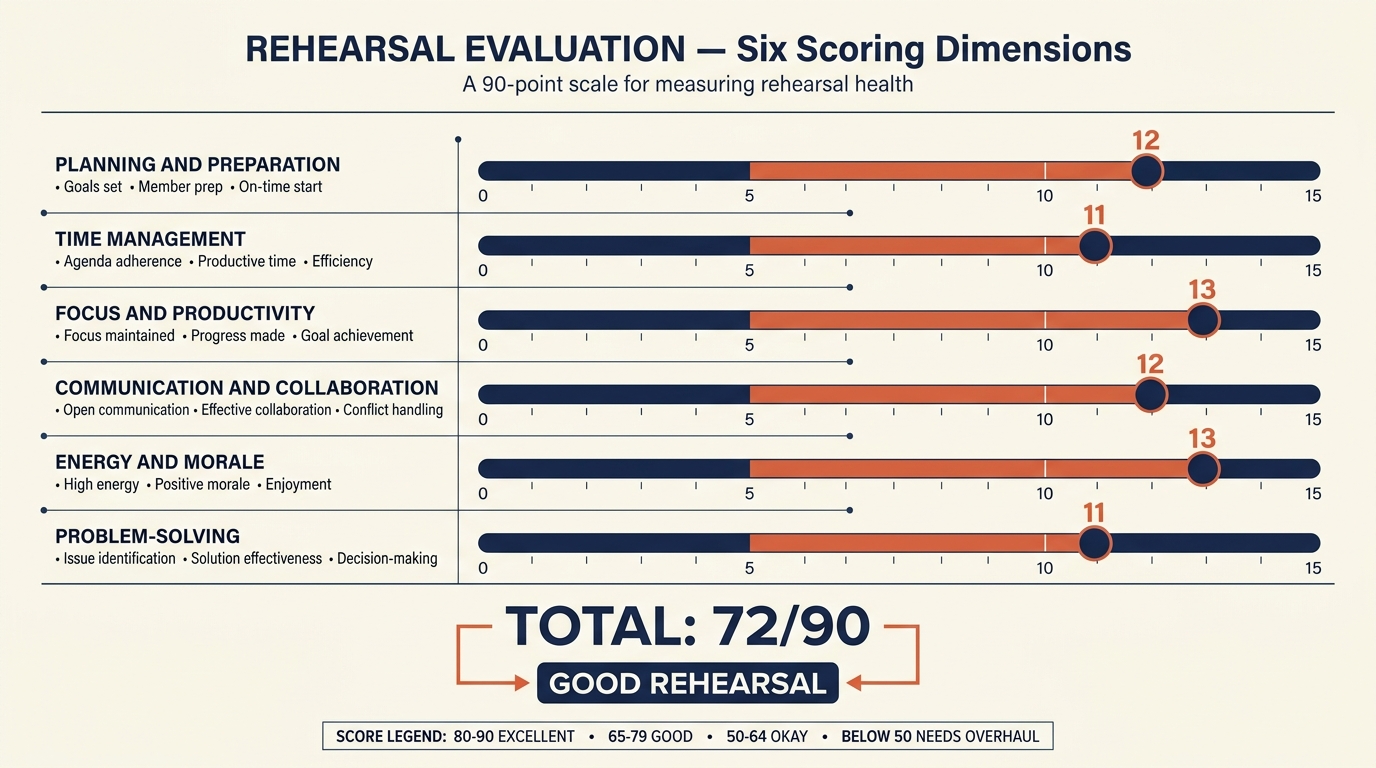
Tool for evaluating rehearsal effectiveness. The goal is a filled scorecard: five honest numbers, one fix, and the name of whoever owns it.
Scoring rhythm: jot the start-time, agenda-percent, and show-ready scores before load-out, then review a month of cards together when the same weak number keeps repeating.
Evaluation asks whether rent money bought readiness—or only burned hours. Honest scores change behavior; fake fives protect feelings and waste lockouts.
Metrics that matter
Score five things after every session: how many minutes late the downbeat happened, what share of the planned agenda got finished, how many songs moved closer to show-ready, the room’s energy, and whether last week’s practice assignments actually landed. Vibes are not evidence, because a fun night of noodling feels great and still rents you nothing.
Close the scoring with one win, one fix, and one person who owns that fix, so the conversation points at the next session instead of becoming a courtroom. After four weeks of the same five numbers, patterns emerge: if start delay is always the worst score, the problem is scheduling, while repeated homework misses point at people.
Patterns over blame
When the same member is the story every week, look at the system before the person: maybe the agendas were vague, the targets impossible for a parent of two, or the charts never arrived. A bassist who “never prepares” may simply have received the Dropbox link twelve hours before the session.
Genuine chronic issues still deserve a direct private conversation rather than a public scoring ambush at the end of practice. Structure first, character second: fix the broken inputs you can measure, and only then conclude that the seat itself is the problem rather than the setup around it.
Cadence
Scoring every rehearsal, or every second one, is plenty; daily critique turns a hobby band into an HR department. A five-minute huddle before load-out beats a separate meeting, because the details are fresh and nobody has to drive back for a talking circle.
Critique without celebration curdles into culture poison within a month, so tie the numbers to milestones the band actually cares about. Announcing that all twelve songs are now show-ready for the October support slot lands better than another lecture about tardiness, and it gives the scores a reason to exist.
Fill-in: Session score
Start on time?: ________
Agenda %: ________
Show-ready gains: ________
One fix: ________
Owner: ________
Putting it into practice
Score the next rehearsal before you leave the room.
FAQ
What metrics matter for rehearsal quality?
Starts on time, percent of agenda completed, songs show-ready, energy, and whether homework landed. Vibes alone are not metrics.
How honest should ratings be?
Honest enough to change behavior. Fake fives protect feelings and waste lockout fees.
What if evaluation always blames one person?
Check whether the system (agenda, charts, leadership) is failing them. Chronic individual issues still need a private conversation.
Can we evaluate without demoralizing?
Lead with one win, one fix, one owner. Evaluation is for the next session, not a courtroom.