Leadership Assessment Tool
DOCX download
Leadership Assessment Tool
Free editable Word guide you can copy, fill in, and share with your band. Also readable on this page.
How to use this guide
Self-assessment tool for band leaders. Score the five dimensions separately, then compare answers and leave with a support plan and a written recheck date.
Cadence: complete the strengths, gaps, support plan, and recheck date once a year, or right after a hard tour or blowup, and compare new scores against the last round.
When leadership is fuzzy or contested, a mirror beats a mutiny. Assessment is diagnostic—not automatically a vote to fire.
Who assesses and why
The person steering fills out the form alone, and members who experience that steering fill it out separately. The gap between the two views is the entire point: a leader who scores their own communication a nine while three members write four has found the exact spot to work.
Run the review once a year, or after a major conflict or a demanding tour season that changed the dynamic. Polling the room every month turns diagnosis into politics, and members start campaigning instead of answering honestly about how decisions actually feel from the passenger seat.
Dimensions that matter in bands
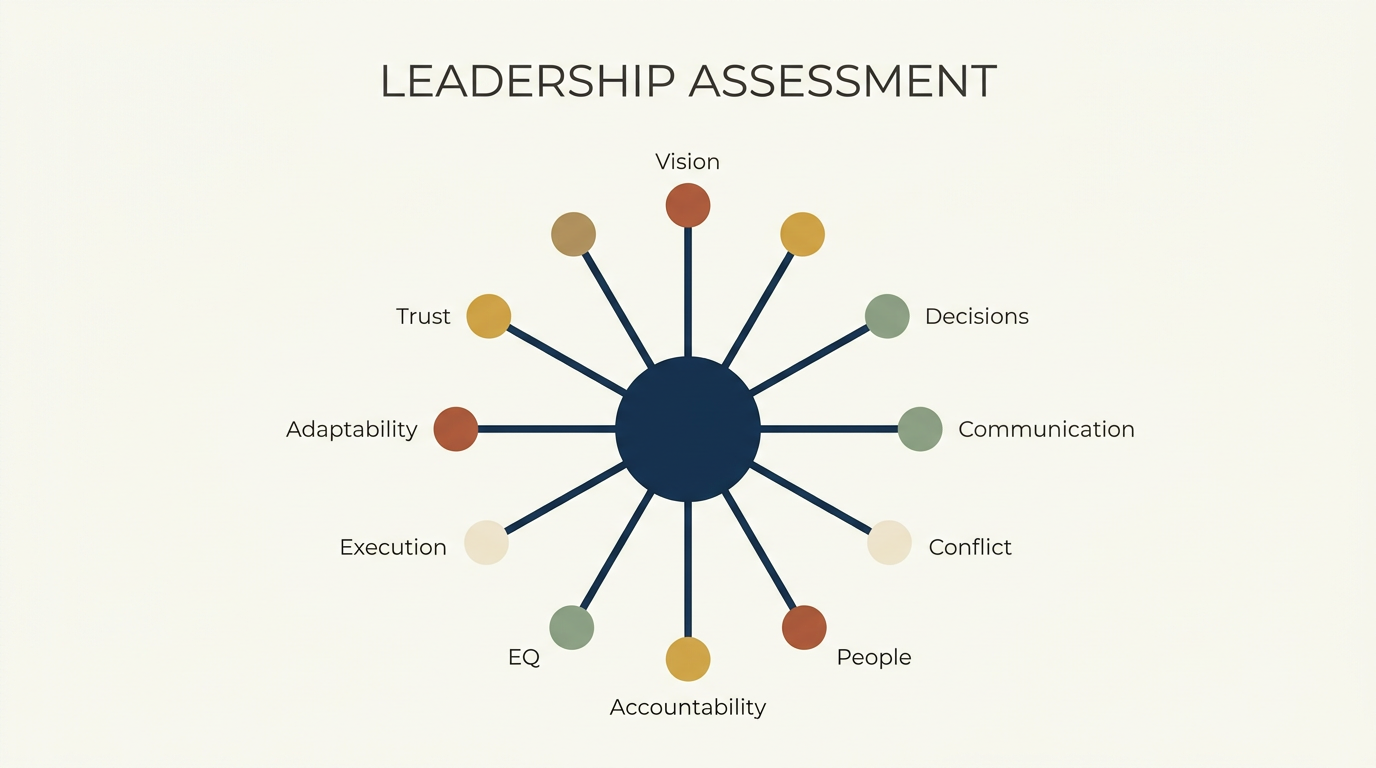
Score five dimensions: clarity of direction, fairness with money and solos, everyday communication, speed of decisions, and emotional regulation under stress. A bandleader who is musically brilliant but melts down at every soundcheck still costs the band, no matter how high the other numbers run.
Collect concrete examples alongside every score so the follow-up conversation stays specific. “Felt dismissed when my setlist suggestion got no reply for two weeks” can be addressed; a bare three-out-of-ten on fairness just starts an argument about what anyone meant, and nothing gets fixed.
Outcomes
Coaching, splitting the role between two people, or full succession are all legitimate results, and so is confirming the current setup genuinely works. What is not legitimate is filing the scores away unchanged, because a diagnostic that ends in nothing teaches members their honesty was wasted.
Close every review with one next step and one recheck date in writing. “Maya takes over booking duties, we rerun this in October” is an actual outcome; a vague promise to communicate better next time is theater the lineup will see through by the second rehearsal.
Fill-in: Assessment snapshot
Strengths: ________
Gaps: ________
Support plan: ________
Recheck date: ________
Putting it into practice
Run a light assessment after the next intense month.
FAQ
Who should complete a leadership assessment?
The current leader and, separately, members who experience the leadership. Gaps between self-view and peer view are the point.
Is this a vote to fire the leader?
Not automatically. It is diagnostic. Outcomes can be coaching, role split, or succession—not only removal.
What dimensions matter in bands?
Vision clarity, fairness, communication, decision speed, and emotional regulation under stress.
How often should we assess?
Annually, or after major conflict/tour seasons. Constant assessment becomes politics.