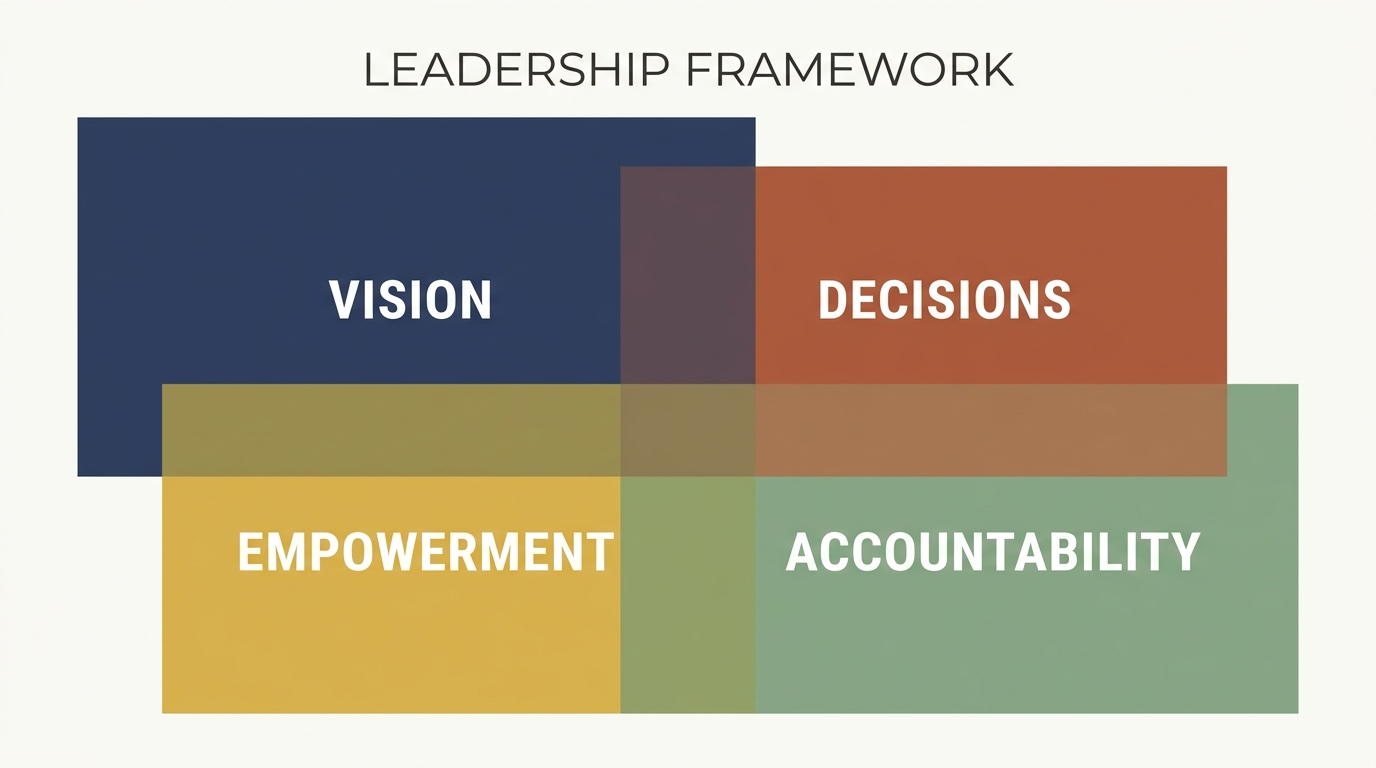
Leadership Framework for Band Leaders
DOCX download
Leadership Framework for Band Leaders
Free editable Word guide you can copy, fill in, and share with your band. Also readable on this page.
How to use this guide
Comprehensive framework for band leadership with practical applications. Fill every blank and you finish holding a one-page map that names who owns music, money, and booking calls, plus the tie-break rule.
Suggested workflow: draft the map solo, settle the four blanks in one band meeting, pin the page inside the rehearsal room, and redraw owners whenever a member joins or departs.
Bands need decision rights under stress. Leadership is a function—clear domains, fair process, service to the music—not a crown and not a personality contest.
Domains over ego
Split the four big domains — set lists and arrangements, cash, gigs, and how people treat each other — across the members best suited to each, then write down who has the final say when a vote deadlocks. Invisible ownership creates invisible resentment, and secret power struggles surface at the worst possible moment, usually mid-tour.
When two people both believe they own outreach to venues, you do not have collaboration; you have a collision that ends in a double-booked Friday and an awkward apology call. A one-page chart taped inside the rehearsal room door settles turf questions before they turn personal.
Behaviors that scale
Clear agendas, on-time starts, written outcomes, shared credit, and early hard conversations carry a band further than one magnetic personality, because charisma without systems collapses on tour when sleep and patience run short. A leader who starts rehearsal at seven sharp every Tuesday teaches reliability better than any speech.
Leaders who cannot hear criticism become bottlenecks, so pair authority with a scheduled feedback channel where truth travels upward safely. Ten minutes of round-robin after the first rehearsal of each month gives gripes a legitimate exit instead of letting them ferment in the parking lot.
Authority with accountability
Somebody has to break ties, and that somebody must also answer for whether the process felt fair and got explained. A tie-breaker who announces a verdict without reasoning teaches the losers to litigate every future call, while one who explains the why builds trust even in defeat.
Authority without accountability is unaccountable power wearing a nicer jacket, and members read the difference fast. If the person who decides also reports back — what was chosen, why, and how it worked out after the gig — the role reads as service instead of control.
Fill-in: Our leadership map
Music decisions: ________
Money decisions: ________
Booking decisions: ________
Tie-break rule: ________
Putting it into practice
Write domain owners this week and share with every member.
FAQ
What is the difference between leading a band and running a dictatorship?
Leaders set vision, make timely calls, empower people, and address problems; dictators skip input, own every detail, and treat collaborators like employees. Say which decision level you are using (leader decides, input then decide, consensus, or delegate) so authority never pretends to be fake democracy.
How do servant-leadership principles apply when a hard call is due tonight?
Serve the band's success, not your ego: gather the minimum input you can, decide, explain the why, and own the outcome. Listening first still matters under time pressure—you just do not let endless debate miss the load-in. Pair this page with the servant leadership guide for day-to-day posture.
How should a new bandleader introduce this framework without a mutiny?
Present it as shared infrastructure: "Here is how I want to lead—tell me what is missing." Run a short self-assessment, pick one visible improvement (faster decisions or 48-hour issue handling), and ask for feedback after a month. Authority that arrives as surprise control fails; authority that arrives as clarity usually sticks.
What are the four key leadership responsibilities in practice each month?
(1) Keep vision alive in decisions and talk, (2) make and own calls with a clear process, (3) support members with check-ins and real delegation, and (4) address performance or interpersonal issues within days—not seasons. Score yourself with the leadership assessment so growth is measurable.