Rehearsal Types Guide
DOCX download
Rehearsal Types Guide
Free editable Word guide you can copy, fill in, and share with your band. Also readable on this page.
How to use this guide
Guide to different types of rehearsals and when to use them. You should end with a month of calendar holds that each declare their job.
Monthly habit: pick types for weeks one through three, pin a show-sim date before any gig that matters, and redraw the rotation when the setlist changes.
When every rehearsal feels the same, shows stay undercooked. Types create purpose and match prep to the night’s job.
Rotate intentionally
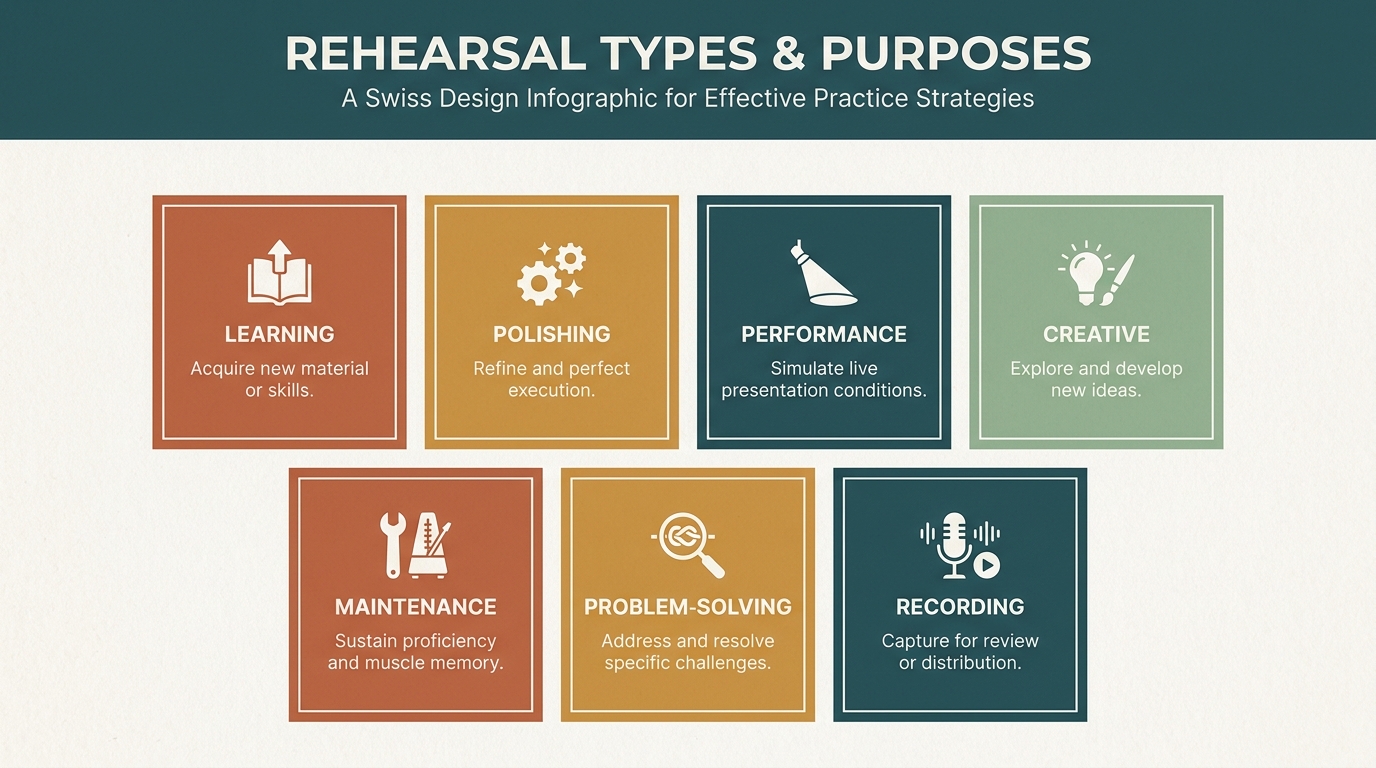
Four flavors cover most of what a working band needs: learning nights for individual parts, arranging nights for structure and transitions, full runs of the set, and troubleshooting nights for the two songs that keep falling apart. Media capture or guest sit-ins are fine as occasional extras, provided they are labeled rather than smuggled into a normal night.
Combining flavors inside one evening only works with hard time boxes on a visible clock, like forty minutes of new material then a strict switch to the run. Without boxes, whichever crisis is loudest eats the whole session and the set never gets its uninterrupted pass.
Show-sims earn their keep
Before any show that matters, play the set in order with the real transitions, banter, and instrument swaps included, because isolated song practice hides exactly the problems audiences notice. Dead air between songs, a missing talk cue, a stamina crash at minute fifty, and an arrangement hole in the closer all surface only in a full pass.
Run it like a low-stakes gig: begin at the scheduled minute, allow at most two emergency stops, and let one person jot observations instead of halting the flow. The findings become the agenda for the next learning night, which is what makes the exercise pay for itself.
Writing days protect creativity
Invention and polish use opposite muscles, so give original material its own evenings instead of expecting a night to both birth a chorus and tighten the endings. Bands that try to master and invent in the same three hours usually finish with neither, plus a bassist resenting the drum machine demo.
Creative nights also need a moat around them: the argument about who pays for the van’s new tires belongs in a business meeting, not between verse sketches. Someone should capture every take on a phone, because the riff that felt disposable at nine in the evening is often the keeper.
Fill-in: Type rotation this month
Week 1 type: ________
Week 2 type: ________
Week 3 type: ________
Show-sim date: ________
Putting it into practice
Label the next four calendar holds with types, not just “rehearsal.”.
FAQ
Which rehearsal types should most bands rotate?
Learning/parts, arranging, full set run, and troubleshooting. Optional: media capture or guest sit-in days.
How do we label the calendar?
Name the type in the calendar event so people prep correctly. “Rehearsal” alone invites noodling.
Can we mix types in one night?
Yes with hard time boxes. Without boxes, the loudest need steals the clock.
How often should we run full set sims?
Before every important show and regularly if you play often. Sims reveal transitions homework cannot.