Preparation Accountability System
Preparation Accountability System
If you've sat through three rehearsals in a row waiting for a guitarist to "figure out the bridge," you already know that preparation isn't a personal-failure problem — it's a system problem. Some bands are disciplined by accident. Most aren't, and the rehearsal suffers for it.
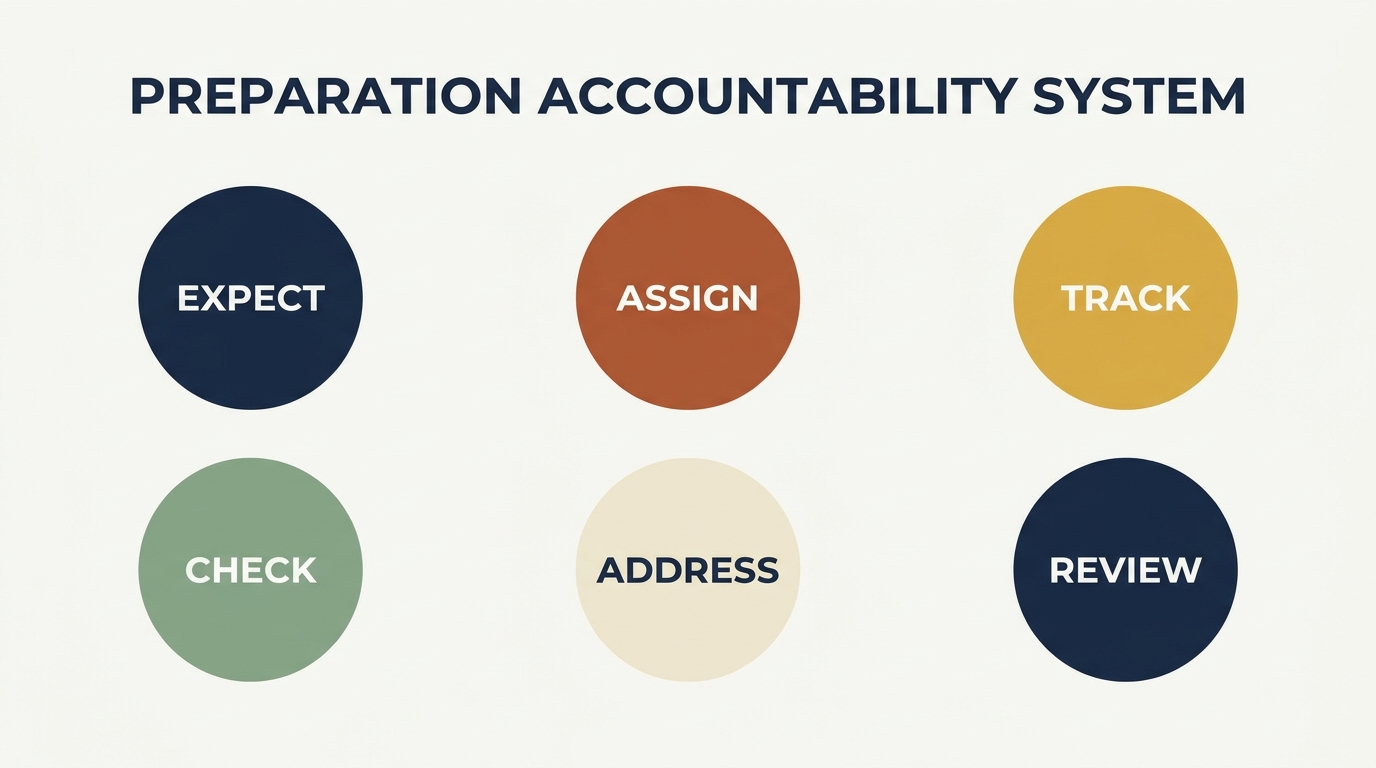
This guide builds a complete preparation accountability system: clear expectations, specific assignments, tracking, check-ins, and escalating responses when someone falls short. It's six steps plus the tools to actually run them — assignment sheets, checklists, a log, and a reminder template you can copy.
Use it from day one if you're starting a new project. Use it now if you've been tolerating chronic unpreparedness and you're tired of the wasted hours. The hardest part is the second time someone shows up unprepared and you actually follow through — that's where the system either takes hold or quietly dies. Most bands have one member who's been getting away with chronic unpreparedness for months; the rest of the band has been talking about it privately and waiting for someone else to bring it up. This guide gives you a way to bring it up without making it personal — by changing the conversation from "you have a problem" to "we have a system, and here's how it works."
Why Preparation Matters
When everyone is prepared:
- Productive rehearsals
- Faster progress
- Better results
- Respect for each other's time
- Higher morale
- More fun
When people aren't prepared:
- Wasted time
- Frustration
- Slow progress
- Resentment builds
- Lower morale
- Less fun
The Problem with Preparation
It's tempting to think of unpreparedness as a motivation problem — that people would prepare if they cared more. That framing is usually wrong, and it leads to frustration that doesn't fix anything. The next section walks through the actual reasons people don't prepare and why the real cause is almost always structural, not personal.
Why People Don't Prepare
Common reasons:
- Forgot what to practice
- Didn't have time
- Didn't think it mattered
- Thought they could wing it
- Other priorities
- No accountability
The real issue:
- No clear expectations
- No tracking system
- No consequences
- No accountability
The Preparation Accountability System
Knowing the diagnosis isn't the same as having a treatment. The next section is the treatment: six concrete steps that take you from "we'd like people to prepare more" to a functioning system with assignments, tracking, check-ins, and escalating consequences. Read through it once end-to-end before you start implementing — the steps build on each other.
Step 1: Set Clear Expectations
Define what "prepared" means:
For new songs:
- Listened to reference recording
- Learned your part
- Can play at tempo
- Know structure
- Practiced transitions
For existing songs:
- Reviewed parts
- Practiced problem areas
- Can play from memory
- Ready to perform
For rehearsal:
- Know what we're working on
- Completed assigned practice
- Equipment ready
- On time
Step 2: Assign Specific Practice
Don't say: "Practice the new song"
Do say:
- "Learn the verse and chorus of 'Song X'"
- "Practice the bridge transition in 'Song Y'"
- "Work on timing in the intro of 'Song Z'"
- "Memorize lyrics for 'Song A'"
Use the Practice Assignment Template:
Member: _______________ For rehearsal on: _______________
Assignments:
- Specific focus: _______________
- Success criteria: _______________
- Specific focus: _______________
- Success criteria: _______________
- Specific focus: _______________
- Success criteria: _______________
Step 3: Track Preparation
Use the Preparation Tracker:
Rehearsal Date: _______________
| Member | Assignment 1 | Assignment 2 | Assignment 3 | Overall |
|---|---|---|---|---|
| Name | ✓ / ✗ | ✓ / ✗ | ✓ / ✗ | ✓ / ✗ |
| Name | ✓ / ✗ | ✓ / ✗ | ✓ / ✗ | ✓ / ✗ |
| Name | ✓ / ✗ | ✓ / ✗ | ✓ / ✗ | ✓ / ✗ |
| Name | ✓ / ✗ | ✓ / ✗ | ✓ / ✗ | ✓ / ✗ |
Notes:
Step 4: Check Preparation
At start of rehearsal (5 minutes):
Quick check-in: "Let's quickly check in on preparation. Who's ready to go on Song X?"
Individual check:
- "Did you learn the verse?"
- "Can you play the bridge?"
- "Do you know the structure?"
Don't:
- Shame people
- Spend too long
- Make excuses
- Skip this step
Step 5: Address Unpreparedness
If someone isn't prepared:
First time: "Okay, let's work on something else while you catch up. Can you have it ready by next rehearsal?"
Second time: "This is the second time. What's going on? How can we help you be prepared?"
Third time: "This is becoming a pattern. We need to talk about this. Can we chat after rehearsal?"
Step 6: Implement Consequences
Establish consequences in advance:
Agreed-upon consequences:
- First time: Warning, work on something else
- Second time: Conversation about what's wrong
- Third time: Consequence
- Pattern: Consequence
Possible consequences:
- Pay for rehearsal space that day
- Bring snacks next time
- Extra practice assignment
- Sit out that song
- Formal warning
- If pattern continues: Membership review

Document in band agreement
Preparation Tools
The system only works if the busywork of running it doesn't take more time than the rehearsal itself. The next section provides four copy-paste tools — an assignment sheet, a personal checklist, a preparation log, and a reminder email template — designed to keep the administrative load under five minutes per cycle. Don't reinvent these from scratch; use them as-is and customize after the system has a few weeks to settle.
Tool 1: Practice Assignment Sheet
Distributed at end of each rehearsal:
Band: _______________ Next Rehearsal: _______________
All Members:
- Assignment 1: _______________
- Assignment 2: _______________
- Assignment 3: _______________
Member Name:
- Assignment 1: _______________
- Assignment 2: _______________
- Assignment 3: _______________
Member Name:
- Assignment 1: _______________
- Assignment 2: _______________
- Assignment 3: _______________
Member Name:
- Assignment 1: _______________
- Assignment 2: _______________
- Assignment 3: _______________
Member Name:
- Assignment 1: _______________
- Assignment 2: _______________
- Assignment 3: _______________
Tool 2: Preparation Checklist
For each member to use:
For next rehearsal on: _______________
My assignments:
- _______________
- _______________
- _______________
General preparation:
- Reviewed rehearsal agenda
- Listened to recordings
- Practiced assigned material
- Equipment ready
- Know what we're working on
Self-assessment:
- I'm fully prepared
- I'm mostly prepared
- I'm somewhat prepared
- I'm not prepared
If not fully prepared, why?
What I need:
Tool 3: Preparation Log
Track preparation over time:
| Date | Member | Prepared? | Notes |
|---|---|---|---|
| 1/1 | Name | ✓ | |
| 1/1 | Name | ✗ | Forgot |
| 1/8 | Name | ✓ | |
| 1/8 | Name | ✓ |
Monthly summary:
January:
- Member 1: 4/4 (100%)
- Member 2: 3/4 (75%)
- Member 3: 4/4 (100%)
- Member 4: 2/4 (50%)
Tool 4: Preparation Reminder
Send 2-3 days before rehearsal:
Subject: Rehearsal Prep Reminder - Date
Hi everyone,
Quick reminder that we have rehearsal on date at time.
What we're working on:
- Song 1
- Song 2
- Song 3
Your assignments:
Everyone:
- General assignment
See you there!
Making It Work
The system only works if you actually run it — and running a new system is where most bands quietly let it die. The next section covers the practical habits that make the difference: starting from day one, making it easy, being consistent, addressing issues quickly, and recognizing the people who do prepare. None of this is complicated. All of it requires discipline.
1. Start from Day One
Establish from the beginning:
- This is how we work
- Preparation is expected
- We track it
- There are consequences
Don't:
- Wait until it's a problem
- Spring it on people
- Be inconsistent
2. Make It Easy
Help people prepare:
- Clear assignments
- Reference recordings
- Practice tracks
- Written instructions
- Reminders
Remove barriers:
- Reasonable assignments
- Adequate time
- Resources provided
- Support available
3. Be Consistent
Every rehearsal:
- Assign practice
- Send reminders
- Check preparation
- Track results
- Address issues
Don't:
- Skip sometimes
- Let it slide
- Make exceptions
- Be inconsistent
4. Address Issues Promptly
Don't let it build:
- Address first time
- Have conversation second time
- Implement consequences third time
- Don't wait until you're angry
5. Recognize Preparation
Acknowledge when people are prepared:
- "Great job being ready"
- "I can tell you practiced"
- "Thanks for being prepared"
- "This is why we make progress"
Celebrate:
- When everyone is prepared
- When someone improves
- When it becomes habit
Common Challenges
Challenge 1: "I Didn't Have Time"
Response: "I understand life gets busy. How much time do you need? Can we adjust assignments? Or is this not the right time for you to be in a band?"
Solution:
- Adjust assignments if reasonable
- Help prioritize
- Or acknowledge misalignment
Challenge 2: "I Forgot"
Response: "Okay, let's make sure you don't forget next time. Do you need reminders? Should we write it down?"
Solution:
- Send reminders
- Written assignments
- Calendar invites
- Accountability partner
Challenge 3: "I Thought I Could Wing It"
Response: "That's not fair to everyone else. We all prepare. We need you to do the same."
Solution:
- Clarify expectations
- Explain impact
- Implement consequences
Challenge 4: "It's Not That Important"
Response: "It is important. It's about respecting everyone's time. If you don't think it's important, maybe this isn't the right band for you."
Solution:
- Clarify values
- Assess fit
- Make hard decision if needed
Preparation Accountability Checklist
Setup
- Defined what "prepared" means
- Established consequences
- Created tracking system
- Communicated expectations
- Got buy-in from everyone
Each Rehearsal
- Assigned specific practice
- Sent written assignments
- Sent reminder 2-3 days before
- Checked preparation at start
- Tracked results
- Addressed issues
- Recognized preparation
Monthly
- Reviewed preparation rates
- Addressed patterns
- Adjusted system as needed
- Celebrated improvements
Key Takeaways
- Set clear expectations - Define what "prepared" means
- Assign specific practice - Not vague "practice the song"
- Track preparation - What gets measured gets done
- Check at rehearsal - Don't assume
- Address issues promptly - Don't let it build
- Implement consequences - Accountability requires consequences
- Recognize preparation - Acknowledge when people do it right
Preparation accountability ensures everyone respects each other's time and maximizes rehearsal productivity. Implement this system and watch your progress accelerate.
Subscribe to our newsletter
Get the latest news and updates.
No spam. Unsubscribe anytime.


Bandmate® is the complete platform for musicians, bands, and venues to connect, collaborate, and grow. Find bandmates, discover venues, and build your music career with tools designed by musicians, for musicians.