Rehearsal Planning Template
Rehearsal Planning Template
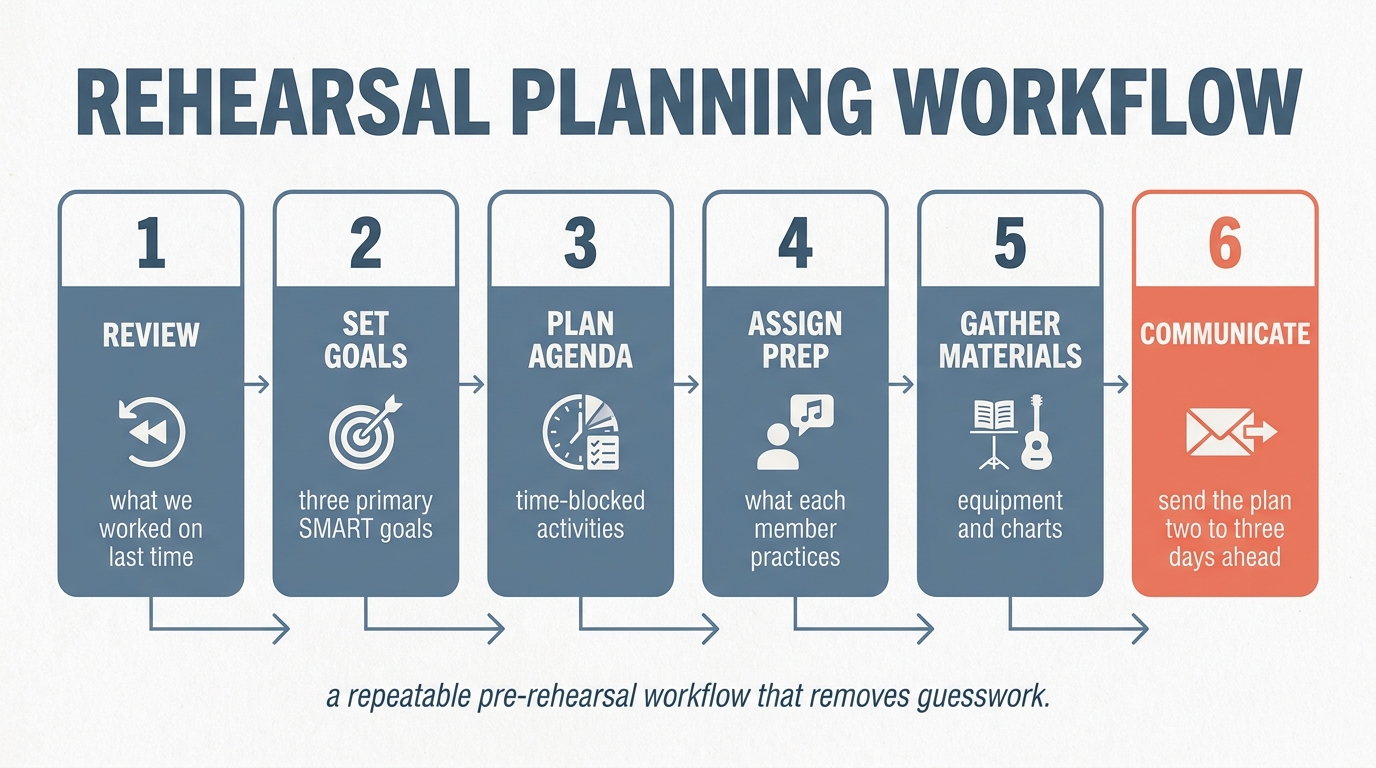
Planning makes the difference between productive rehearsals and wasted time. This template helps you plan effective rehearsals.
Why Plan Rehearsals?
With planning:
- Clear goals
- Efficient use of time
- Everyone prepared
- Productive sessions
- Faster progress
- Less frustration
Without planning:
- Unclear goals
- Wasted time
- People unprepared
- Unproductive
- Slow progress
- Frustration
Rehearsal Planning Template
Basic Information
Date: _______________ Time: _______________ to _______________ Duration: ___ hours Location: _______________ Attendees: _______________
Pre-Rehearsal Planning
1. Review Last Rehearsal
What did we work on?
What did we achieve?
What's remaining?
Action items completed?
- Item 1
- Item 2
- Item 3
2. Set Goals
Primary goals (must achieve):
Secondary goals (if time allows):
Success criteria:
- Goal 1: _______________
- Goal 2: _______________
- Goal 3: _______________
3. Plan Agenda
Time-blocked agenda:
Setup (10 minutes):
- Arrive and set up equipment
- Sound check
- Get ready
Check-in (5 minutes):
- Review goals
- Confirm agenda
- Address any issues
Activity 1 (__ minutes):
- What: _______________
- Goal: _______________
- Approach: _______________
Activity 2 (__ minutes):
- What: _______________
- Goal: _______________
- Approach: _______________
Break (10 minutes):
- Rest and recharge
Activity 3 (__ minutes):
- What: _______________
- Goal: _______________
- Approach: _______________
Activity 4 (__ minutes):
- What: _______________
- Goal: _______________
- Approach: _______________
Wrap-up (10 minutes):
- Review what we achieved
- Set action items
- Plan next rehearsal
Breakdown (10 minutes):
- Pack up equipment
- Clean up space
4. Preparation Requirements
Everyone needs to:
- _______________
- _______________
- _______________
Member 1 needs to:
- _______________
- _______________
Member 2 needs to:
- _______________
- _______________
Member 3 needs to:
- _______________
- _______________
Member 4 needs to:
- _______________
- _______________
5. Materials Needed
Equipment:
- _______________
- _______________
- _______________
Materials:
- Lyric sheets
- Chord charts
- Reference recordings
- Recording device
- Other: _______________
Who's bringing what:
6. Communication
Send to band (2-3 days before):
Subject: Rehearsal Plan - Date
Hi everyone,
We have rehearsal on date at time at location.
Goals:
Agenda:
Please prepare:
Please bring:
See you there!
Time-Blocking Guide
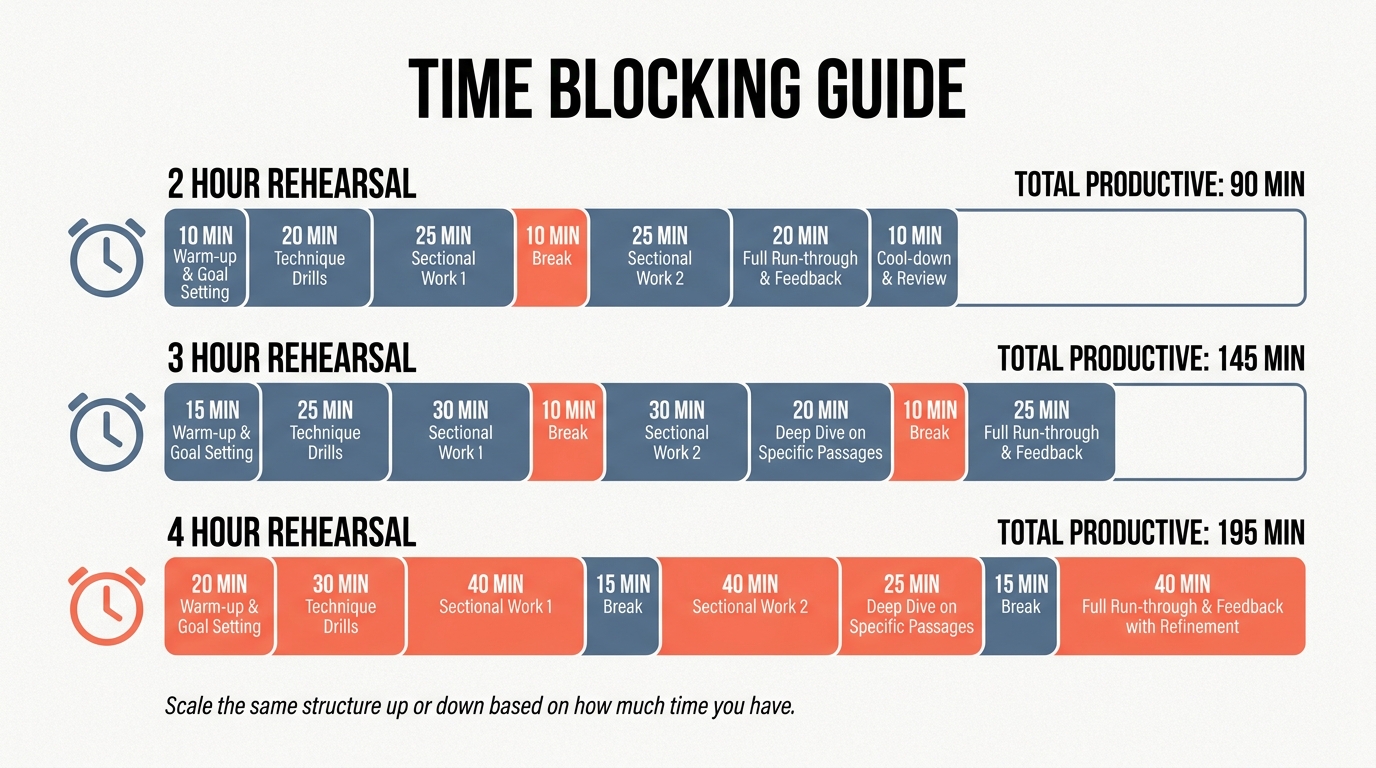
2-Hour Rehearsal
Setup (10 min): 7:00-7:10 Check-in (5 min): 7:10-7:15 Activity 1 (30 min): 7:15-7:45 Activity 2 (30 min): 7:45-8:15 Break (10 min): 8:15-8:25 Activity 3 (25 min): 8:25-8:50 Wrap-up (10 min): 8:50-9:00
Total productive time: 90 minutes
3-Hour Rehearsal
Setup (10 min): 7:00-7:10 Check-in (5 min): 7:10-7:15 Activity 1 (40 min): 7:15-7:55 Activity 2 (40 min): 7:55-8:35 Break (15 min): 8:35-8:50 Activity 3 (35 min): 8:50-9:25 Activity 4 (25 min): 9:25-9:50 Wrap-up (10 min): 9:50-10:00
Total productive time: 145 minutes
4-Hour Rehearsal
Setup (15 min): 1:00-1:15 Check-in (5 min): 1:15-1:20 Activity 1 (50 min): 1:20-2:10 Activity 2 (50 min): 2:10-3:00 Break (15 min): 3:00-3:15 Activity 3 (45 min): 3:15-4:00 Activity 4 (45 min): 4:00-4:45 Wrap-up (15 min): 4:45-5:00
Total productive time: 195 minutes
Planning by Rehearsal Type
Learning New Material
Goals:
- Learn X new songs to Y% proficiency
- Identify problem areas
- Assign practice for next time
Time allocation:
- 40% learning parts
- 30% playing through
- 20% identifying issues
- 10% planning next steps
Approach:
- Break songs into sections
- Learn section by section
- Play through full song
- Note what needs work
Polishing Existing Material
Goals:
- Polish X songs to performance-ready
- Tighten transitions
- Perfect problem areas
Time allocation:
- 20% identifying issues
- 50% working on issues
- 30% running through
Approach:
- Identify weak spots
- Drill problem areas
- Run through multiple times
- Record and review
Pre-Show Rehearsal
Goals:
- Run through full setlist
- Practice transitions
- Build confidence
Time allocation:
- 10% warm-up
- 70% running setlist
- 10% problem areas
- 10% final run-through
Approach:
- Simulate show conditions
- Minimal stopping
- Practice stage presence
- Build momentum
Creative/Writing Session
Goals:
- Develop X song ideas
- Experiment with sounds
- Capture ideas
Time allocation:
- 30% generating ideas
- 40% developing ideas
- 20% recording ideas
- 10% organizing ideas
Approach:
- Free exploration
- No judgment
- Record everything
- Organize later
Problem-Solving Rehearsal
Goals:
- Resolve specific issues
- Make decisions
- Clear blockers
Time allocation:
- 20% identifying problems
- 50% solving problems
- 20% testing solutions
- 10% documenting decisions
Approach:
- List all issues
- Prioritize
- Address one by one
- Test and confirm
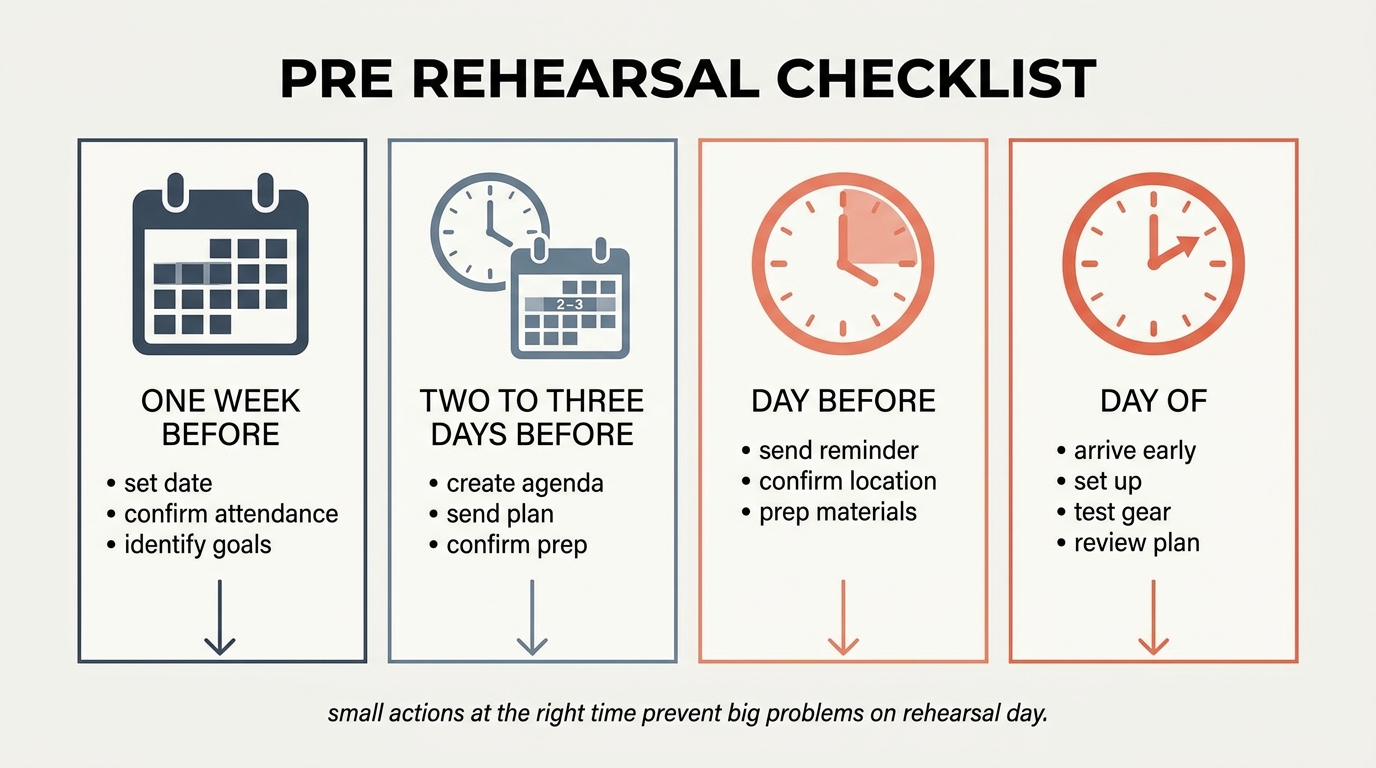
Pre-Rehearsal Checklist
1 Week Before
- Set date, time, location
- Confirm attendance
- Identify goals
- Assign preparation
2-3 Days Before
- Create detailed agenda
- Send rehearsal plan
- Confirm preparation
- Confirm equipment needs
Day Before
- Send reminder
- Confirm attendance
- Confirm location
- Prepare materials
Day Of
- Arrive early
- Set up space
- Test equipment
- Review plan
During Rehearsal
Start Strong
Check-in (5 minutes):
- Review goals
- Confirm agenda
- Address any issues
- Get buy-in
Stay on Track
Timekeeper role:
- Assign someone
- Watch the clock
- Keep to schedule
- Adjust if needed
Stay focused:
- Minimize distractions
- Stay on task
- Take planned breaks
- Avoid tangents
End Well
Wrap-up (10 minutes):
- Review achievements
- Celebrate progress
- Set action items
- Plan next rehearsal
After Rehearsal
Immediate (Within 1 Hour)
- Document what we achieved
- Note what's remaining
- Capture ideas
- Record action items
Within 24 Hours
- Send rehearsal notes
- Share recordings
- Confirm action items
- Schedule next rehearsal
Before Next Rehearsal
- Review notes
- Complete action items
- Prepare materials
- Plan next rehearsal
Planning Tips
1. Plan Backwards
Start with goals:
- What do we want to achieve?
- What activities will get us there?
- How much time for each?
- What preparation is needed?
2. Build in Buffer
Don't over-schedule:
- Things take longer than expected
- Need flexibility
- Allow for exploration
- Build in breaks
Rule of thumb:
- Plan for 80% of available time
- Leave 20% as buffer
3. Vary Activities
Mix it up:
- Don't do same thing all rehearsal
- Alternate intense and light
- Change focus regularly
- Keep energy up
4. Prioritize Ruthlessly
Focus on what matters:
- What's most important?
- What's urgent?
- What will have biggest impact?
- What can wait?
5. Communicate Clearly
Everyone should know:
- Goals for rehearsal
- What to prepare
- What to bring
- What to expect
Key Takeaways
- Plan every rehearsal - Don't wing it
- Set clear goals - Know what you're working toward
- Time-block activities - Allocate time intentionally
- Communicate in advance - Everyone should be prepared
- Build in buffer - Things take longer than expected
- Stay flexible - Adjust as needed
- Review and improve - Learn from each rehearsal
Planning transforms rehearsals from jam sessions into productive work sessions. Start planning your next rehearsal today.
Subscribe to our newsletter
Get the latest news and updates.
No spam. Unsubscribe anytime.


Bandmate® is the complete platform for musicians, bands, and venues to connect, collaborate, and grow. Find bandmates, discover venues, and build your music career with tools designed by musicians, for musicians.