Rehearsal Evaluation Tool
Rehearsal Evaluation Tool
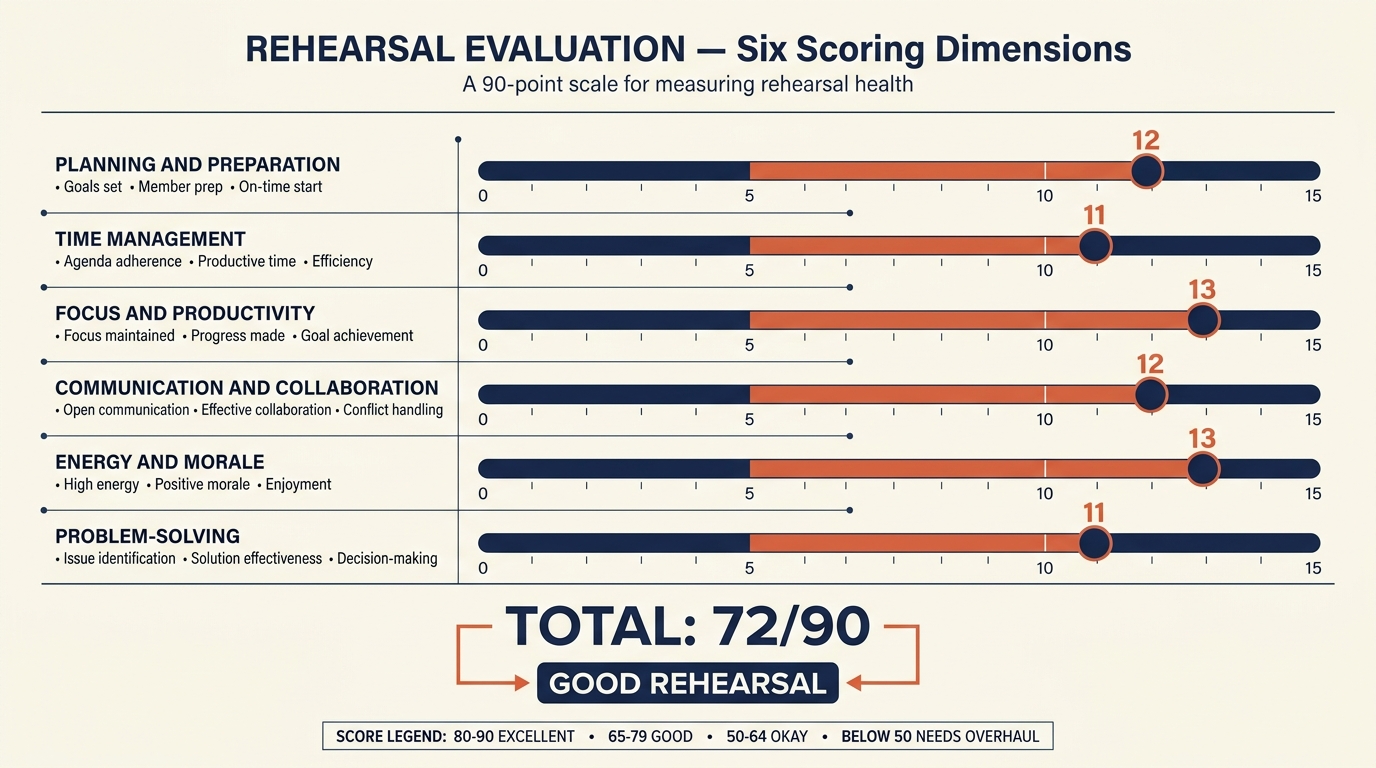
You can't improve what you don't evaluate. This tool helps you assess rehearsal effectiveness and identify improvements.
Why Evaluate Rehearsals?
With evaluation:
- Identify what's working
- Spot what's not working
- Make data-driven improvements
- Track effectiveness over time
- Increase productivity
- Better use of time
Without evaluation:
- Repeat same mistakes
- Don't know what to improve
- Waste time
- Frustration builds
- Slow progress
Quick Rehearsal Evaluation
Use after every rehearsal (5 minutes):
Overall Rating
How productive was this rehearsal? (1-10)
1-3: Waste of time 4-6: Somewhat productive 7-8: Productive 9-10: Highly productive
Rating: ___/10
Quick Assessment
Did we achieve our goals?
- Yes, all of them
- Most of them
- Some of them
- No
Was everyone prepared?
- Yes, everyone
- Most people
- Some people
- No
Did we use time well?
- Yes, very efficient
- Mostly efficient
- Somewhat efficient
- No, wasted time
Would I want to repeat this rehearsal?
- Yes, it was great
- Yes, with some changes
- No, needs major changes
- No, it was a waste
Detailed Rehearsal Evaluation
Use monthly or when needed (15 minutes):
1. Planning & Preparation
Did we have clear goals?
- Yes, very clear (5 points)
- Somewhat clear (3 points)
- Vague (1 point)
- No goals (0 points)
Was everyone prepared?
- Yes, everyone (5 points)
- Most people (3 points)
- Some people (1 point)
- No one (0 points)
Did we start on time?
- Yes, on time (5 points)
- Within 10 minutes (3 points)
- 10-20 minutes late (1 point)
- More than 20 minutes late (0 points)
Planning & Preparation Score: ___/15
2. Time Management
Did we follow the agenda?
- Yes, closely (5 points)
- Mostly (3 points)
- Somewhat (1 point)
- No agenda or didn't follow (0 points)
How much time was productive?
- 80-100% (5 points)
- 60-80% (3 points)
- 40-60% (1 point)
- Less than 40% (0 points)
Did we manage time well?
- Yes, efficient (5 points)
- Mostly efficient (3 points)
- Somewhat inefficient (1 point)
- Very inefficient (0 points)
Time Management Score: ___/15
3. Focus & Productivity
Did we stay focused?
- Yes, very focused (5 points)
- Mostly focused (3 points)
- Somewhat distracted (1 point)
- Very distracted (0 points)
Did we make progress?
- Significant progress (5 points)
- Good progress (3 points)
- Some progress (1 point)
- No progress (0 points)
Did we achieve our goals?
- All goals (5 points)
- Most goals (3 points)
- Some goals (1 point)
- No goals (0 points)
Focus & Productivity Score: ___/15
4. Communication & Collaboration
Did we communicate well?
- Yes, excellent (5 points)
- Good (3 points)
- Okay (1 point)
- Poor (0 points)
Did we collaborate effectively?
- Yes, very collaborative (5 points)
- Mostly collaborative (3 points)
- Somewhat collaborative (1 point)
- Not collaborative (0 points)
Did we handle disagreements well?
- Yes, constructively (5 points)
- Mostly well (3 points)
- Okay (1 point)
- Poorly (0 points)
Communication & Collaboration Score: ___/15
5. Energy & Morale
What was the energy level?
- High, energized (5 points)
- Good energy (3 points)
- Low energy (1 point)
- Very low, drained (0 points)
What was the morale?
- High, positive (5 points)
- Good (3 points)
- Okay (1 point)
- Low, negative (0 points)
Did people enjoy it?
- Yes, everyone (5 points)
- Most people (3 points)
- Some people (1 point)
- No one (0 points)
Energy & Morale Score: ___/15
6. Problem-Solving
Did we identify issues?
- Yes, clearly (5 points)
- Mostly (3 points)
- Some (1 point)
- No (0 points)
Did we solve problems?
- Yes, effectively (5 points)
- Solved some (3 points)
- Tried but didn't solve (1 point)
- Didn't address (0 points)
Did we make decisions?
- Yes, clear decisions (5 points)
- Some decisions (3 points)
- Few decisions (1 point)
- No decisions (0 points)
Problem-Solving Score: ___/15
Total Score
Add up all sections:
- Planning & Preparation: ___/15
- Time Management: ___/15
- Focus & Productivity: ___/15
- Communication & Collaboration: ___/15
- Energy & Morale: ___/15
- Problem-Solving: ___/15
Total Score: ___/90
Score Interpretation
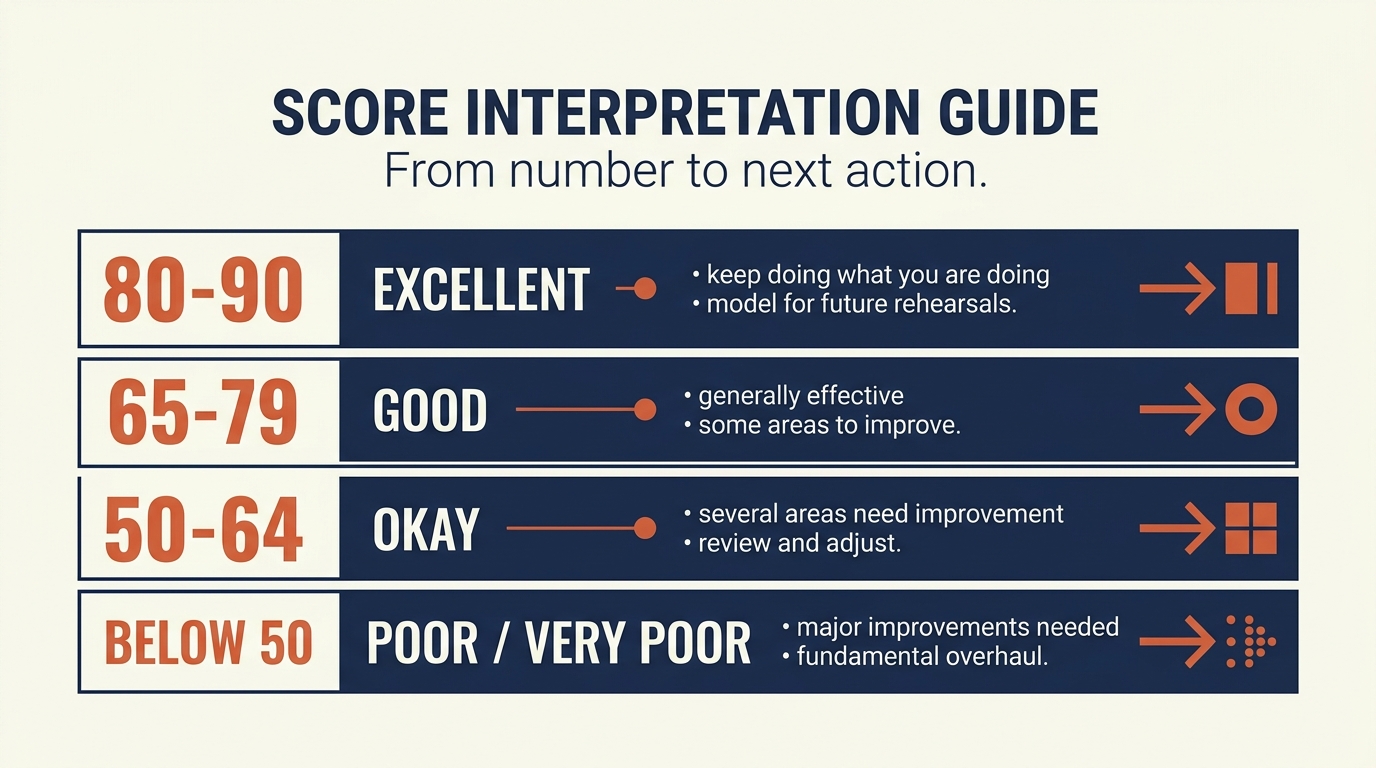
80-90: Excellent rehearsal
- Keep doing what you're doing
- Minor tweaks only
- Model for future rehearsals
65-79: Good rehearsal
- Generally effective
- Some areas to improve
- On the right track
50-64: Okay rehearsal
- Some productivity
- Several areas need improvement
- Review and adjust
35-49: Poor rehearsal
- Low productivity
- Major improvements needed
- Significant changes required
Below 35: Very poor rehearsal
- Waste of time
- Fundamental issues
- Major overhaul needed
What Went Well / What to Improve
What Went Well
List 3 things that went well:
Why did these work?
How can we do more of this?
What Needs Improvement
List 3 things that need improvement:
Why didn't these work?
How can we improve?
Action Items for Improvement
Based on evaluation, what will we change?
For next rehearsal:
Longer-term changes:
Who's responsible:
- Change 1: _______________
- Change 2: _______________
- Change 3: _______________
Tracking Over Time
Create a tracking sheet:
| Date | Total Score | Planning | Time Mgmt | Focus | Communication | Energy | Problem-Solving | Notes |
|---|---|---|---|---|---|---|---|---|
| 1/1 | 72 | 12 | 11 | 13 | 12 | 13 | 11 | |
| 1/8 | 78 | 13 | 12 | 14 | 13 | 13 | 13 | |
| 1/15 | 65 | 10 | 9 | 11 | 12 | 12 | 11 |
Look for:
- Trends over time
- Patterns
- Improvements
- Recurring issues
- What's working
Common Issues & Solutions
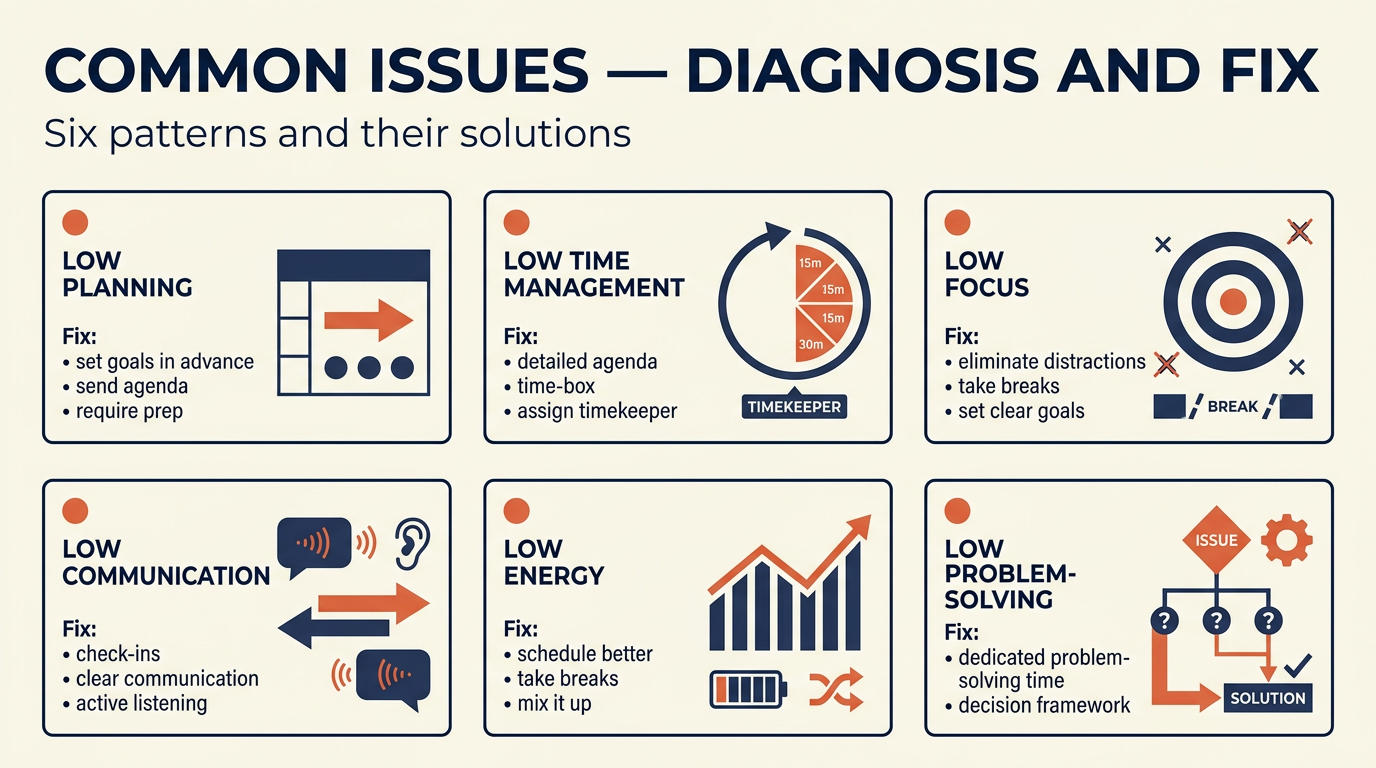
Issue 1: Low Planning Score
Symptoms:
- No clear goals
- People unprepared
- Late starts
Solutions:
- Set goals in advance
- Send agenda ahead
- Require preparation
- Start on time
Issue 2: Low Time Management Score
Symptoms:
- Don't follow agenda
- Waste time
- Inefficient
Solutions:
- Create detailed agenda
- Time-box activities
- Assign timekeeper
- Stay disciplined
Issue 3: Low Focus Score
Symptoms:
- Distracted
- Off-topic
- No progress
Solutions:
- Eliminate distractions
- Take breaks
- Stay on task
- Clear goals
Issue 4: Low Communication Score
Symptoms:
- Poor communication
- Conflicts
- Misunderstandings
Solutions:
- Check-ins
- Clear communication
- Address issues
- Active listening
Issue 5: Low Energy Score
Symptoms:
- Low energy
- Negative morale
- Not enjoying it
Solutions:
- Schedule better
- Take breaks
- Mix it up
- Address issues
Issue 6: Low Problem-Solving Score
Symptoms:
- Don't identify issues
- Don't solve problems
- Avoid decisions
Solutions:
- Dedicated problem-solving time
- Decision-making framework
- Address issues directly
- Make decisions
Individual Evaluation
Each member can also evaluate:
My preparation (1-10): ___
My focus (1-10): ___
My contribution (1-10): ___
My attitude (1-10): ___
What I did well:
What I can improve:
What I'll do differently next time:
Monthly Review
Once a month, review all evaluations:
Average score this month: ___/90
Trend: ↑ Improving / → Stable / ↓ Declining
Strongest areas:
Weakest areas:
Improvements made:
Still need to improve:
Goals for next month:
Key Takeaways
- Evaluate regularly - After every rehearsal
- Be honest - Accurate assessment is key
- Track over time - See trends and patterns
- Identify improvements - Turn insights into action
- Make changes - Evaluation without action is useless
- Review monthly - Big picture assessment
- Celebrate improvements - Acknowledge progress
Regular evaluation helps you continuously improve rehearsal effectiveness. Start evaluating today.
Subscribe to our newsletter
Get the latest news and updates.
No spam. Unsubscribe anytime.


Bandmate® is the complete platform for musicians, bands, and venues to connect, collaborate, and grow. Find bandmates, discover venues, and build your music career with tools designed by musicians, for musicians.