Disengagement Guide
Disengagement Guide
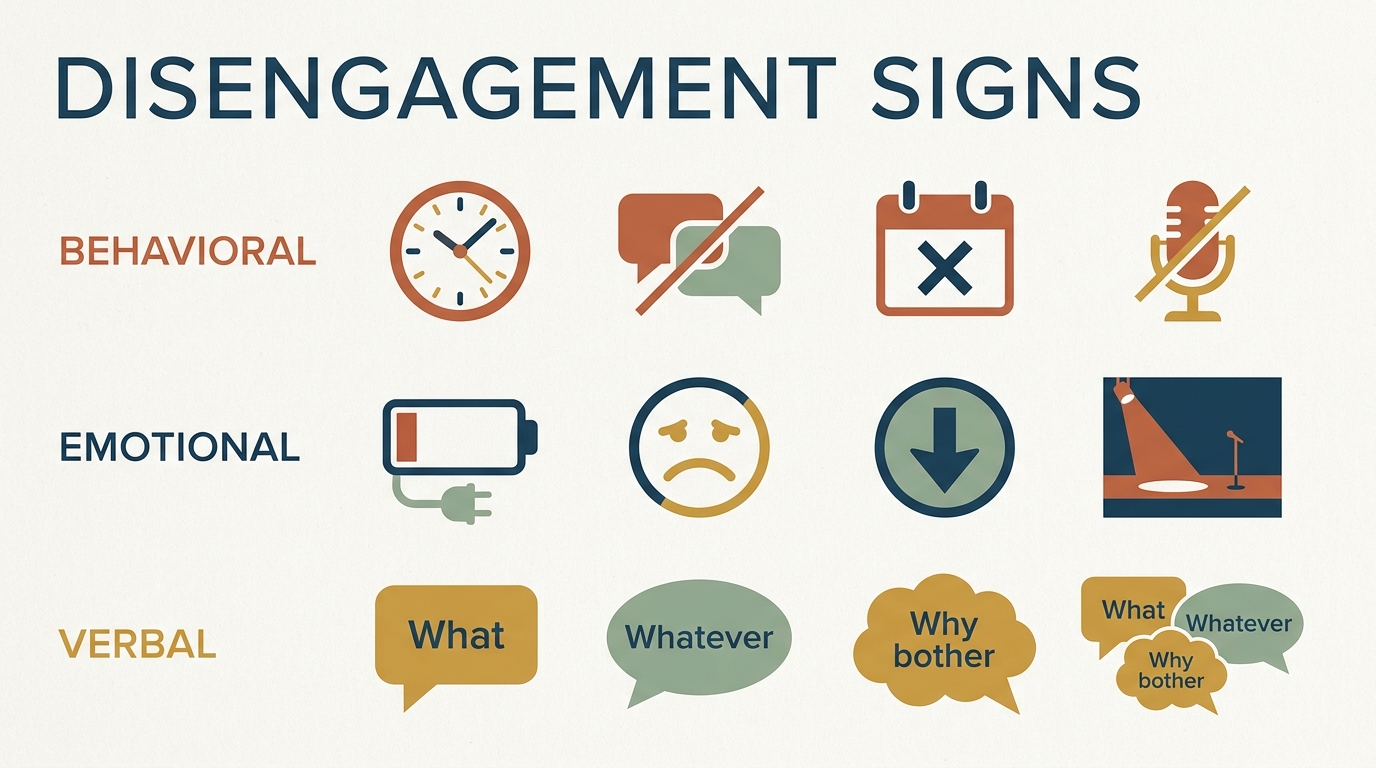
Disengagement is a silent killer of bands. This guide helps you identify disengagement early and address it before it becomes a bigger problem.
What is Disengagement?
Disengagement is:
- Decreased investment in the band
- Going through the motions
- Lack of enthusiasm
- Emotional withdrawal
- Reduced effort
Disengagement is NOT:
- Having a bad day
- Temporary stress
- Disagreeing with decisions
- Being quiet by nature
Why Disengagement Matters
Disengaged members:
- Perform below potential
- Bring down band energy
- Miss commitments
- Eventually leave
- Affect others' engagement
Catching it early:
- Easier to address
- More likely to resolve
- Prevents escalation
- Protects band morale

Signs of Disengagement
Behavioral Signs
Attendance:
- Missing more rehearsals
- Arriving late more often
- Leaving early
- Finding excuses to skip
- Not committing to future dates
Participation:
- Less active in discussions
- Not offering ideas
- Passive in decisions
- Not volunteering for tasks
- Minimal contribution
Preparation:
- Coming unprepared
- Not learning new material
- Less practice between rehearsals
- Declining skill/performance
- Mistakes increasing
Communication:
- Slower to respond
- Shorter responses
- Less initiation
- Not engaging in group chat
- Avoiding one-on-one contact
Emotional Signs
Energy:
- Lower energy at rehearsals
- Less enthusiasm
- Flat affect
- Going through motions
- No excitement about shows
Attitude:
- More negative
- More complaints
- Less optimism
- Cynical comments
- Dismissive of ideas
Connection:
- Less social with band
- Not hanging out outside rehearsal
- Withdrawn from group
- Creating distance
- Less personal sharing
Verbal Signs
What they say:
- "I don't care"
- "Whatever you want"
- "Does it matter?"
- "I'm just here"
- "I don't know why we bother"
- "This isn't going anywhere"
- "I'm not sure about this anymore"
What they don't say:
- No longer sharing ideas
- Not expressing opinions
- Quiet in discussions
- Not asking questions
- No future-oriented talk
Disengagement Assessment
Member: _______________ Date: _______________
Rate each area (1-5):
- 1 = Highly disengaged
- 2 = Somewhat disengaged
- 3 = Neutral
- 4 = Engaged
- 5 = Highly engaged
Attendance & Punctuality: ___/5 Notes: _______________
Participation in Rehearsals: ___/5 Notes: _______________
Preparation & Practice: ___/5 Notes: _______________
Communication Responsiveness: ___/5 Notes: _______________
Energy & Enthusiasm: ___/5 Notes: _______________
Attitude & Positivity: ___/5 Notes: _______________
Social Connection: ___/5 Notes: _______________
Contribution of Ideas: ___/5 Notes: _______________
Commitment to Future: ___/5 Notes: _______________
Overall Engagement: ___/5
Total Score: ___/45
Interpretation:
- 37-45: Highly engaged
- 28-36: Engaged
- 19-27: Somewhat disengaged (address soon)
- 10-18: Disengaged (address immediately)
- Below 10: Severely disengaged (urgent)
Understanding the Cause
Before addressing, understand why they're disengaged
Common Causes
Personal Life:
- Work stress
- Relationship issues
- Family problems
- Health concerns
- Financial stress
- Mental health struggles
Band-Related:
- Conflict with member(s)
- Disagreement with direction
- Feeling undervalued
- Not having fun anymore
- Burnout
- Frustrated with progress
- Role doesn't fit
- Goals misaligned
External:
- Other opportunities
- Changing priorities
- Life stage transition
- Geographic changes
- Time constraints
Addressing Disengagement
Step 1: Observe and Document
Before talking to them:
- Observe patterns
- Document specific examples
- Note timeline
- Consider context
- Check your perception with others
Step 2: Have a Conversation
Schedule a one-on-one:
- Private setting
- Adequate time
- No distractions
- Calm, caring tone
Opening:
"I wanted to check in with you. I've noticed specific observations, and I'm concerned. I care about you and want to understand what's going on. Can we talk about it?"
Examples:
"I've noticed you've seemed less engaged lately. You've missed the last 3 rehearsals, and when you're here, you seem less enthusiastic than usual. I'm concerned and want to understand what's happening."
"I've noticed you've been quieter in our discussions and haven't been offering ideas like you used to. Is everything okay?"
Step 3: Listen
Ask open-ended questions:
- "What's going on for you?"
- "How are you feeling about the band?"
- "Is something bothering you?"
- "What's changed?"
- "What would help?"
Listen for:
- Root cause
- Their perspective
- What they need
- Whether it's fixable
- Their level of commitment
Don't:
- Interrupt
- Get defensive
- Dismiss their feelings
- Jump to solutions
- Make assumptions
Step 4: Understand Their Perspective
Validate their feelings:
- "That makes sense"
- "I can understand why you'd feel that way"
- "Thank you for being honest"
- "I hear you"
Clarify:
- "Help me understand..."
- "Can you give me an example?"
- "What would that look like?"
- "What do you need?"
Step 5: Explore Solutions
If it's personal life:
- "What support do you need from us?"
- "Would taking a break help?"
- "How can we accommodate what you're going through?"
- "What would make this sustainable for you?"
If it's band-related:
- "What would need to change?"
- "How can we address this?"
- "What would make this better for you?"
- "What role would you prefer?"
If it's misalignment:
- "Do you still want to be in this band?"
- "Are our goals still aligned?"
- "Is this still the right fit?"
- "What would make this work for you?"
Step 6: Create Action Plan
If they want to stay:
What will change:
What they commit to:
What band commits to:
Timeline: _______________
Check-in date: _______________
If they're unsure:
"I hear that you're not sure. Why don't you take timeframe to think about it? Let's talk again on date and see where you're at."
If they want to leave:
"I appreciate your honesty. Let's talk about how to handle the transition in a way that works for everyone."
Intervention Strategies

Strategy 1: Reconnect
If cause is disconnection:
- Schedule social time
- One-on-one hangouts
- Team building activities
- Remember why you started
Strategy 2: Re-engage
If cause is boredom/routine:
- Give them new responsibilities
- Try new creative approaches
- Set exciting goals
- Change up rehearsals
Strategy 3: Rebalance
If cause is burnout:
- Reduce their load
- Delegate their tasks
- Encourage break
- Adjust expectations
Strategy 4: Realign
If cause is direction mismatch:
- Revisit band vision
- Find common ground
- Adjust their role
- Or acknowledge misfit
Strategy 5: Recognize
If cause is feeling undervalued:
- Acknowledge contributions
- Give more input
- Increase responsibility
- Show appreciation
Strategy 6: Resolve
If cause is conflict:
- Address the conflict
- Mediate if needed
- Clear the air
- Rebuild relationship
Follow-Up
Check-In Schedule
1 week later:
- "How are you feeling?"
- "Is anything better?"
- "What's still challenging?"
- "What else do you need?"
2 weeks later:
- "I've noticed observations"
- "How do you feel about your engagement?"
- "Is the plan working?"
- "Do we need to adjust?"
1 month later:
- Formal check-in
- Assess improvement
- Celebrate progress or
- Make harder decisions
When Disengagement Doesn't Improve
If after intervention, disengagement continues:
Ask yourself:
- Have we done everything we can?
- Are they trying?
- Is this sustainable?
- What's best for the band?
- What's best for them?
Consider:
- More time
- Different approach
- Role change
- Break
- Departure
Preventing Disengagement
Create Engaging Environment
Regular check-ins:
- Don't wait for problems
- Ask how they're doing
- Show you care
- Stay connected
Meaningful involvement:
- Give everyone a voice
- Value contributions
- Share responsibilities
- Create ownership
Clear purpose:
- Remind why you exist
- Celebrate progress
- Connect to vision
- Make it meaningful
Fun and connection:
- Don't just work
- Enjoy each other
- Celebrate together
- Build relationships
Growth opportunities:
- Help them develop
- Give new challenges
- Support their goals
- Invest in them
Disengagement Checklist
Identifying
- Observed behavioral changes
- Noted emotional signs
- Documented specific examples
- Considered timeline and context
- Checked perception with others
Addressing
- Scheduled private conversation
- Expressed concern with specific examples
- Asked open-ended questions
- Listened without judgment
- Validated their feelings
- Explored root causes
- Discussed solutions together
- Created action plan
- Set check-in date
Following Up
- Checked in at 1 week
- Checked in at 2 weeks
- Formal check-in at 1 month
- Assessed improvement
- Adjusted plan as needed
- Made harder decisions if necessary
Key Takeaways
- Catch it early - Easier to address before it's severe
- Observe patterns - Not just one bad day
- Have the conversation - Don't avoid it
- Listen first - Understand before solving
- Explore causes - Personal, band-related, or external
- Create action plan - Specific changes and timeline
- Follow up - Check in and adjust
Disengagement is addressable if caught early and handled with care. Use this guide to identify and address disengagement before it becomes a bigger problem.
Subscribe to our newsletter
Get the latest news and updates.
No spam. Unsubscribe anytime.


Bandmate® is the complete platform for musicians, bands, and venues to connect, collaborate, and grow. Find bandmates, discover venues, and build your music career with tools designed by musicians, for musicians.