Attendance Expectations Template
Attendance Expectations Template
Clear attendance expectations are the foundation of a productive, reliable band. This template helps you define, communicate, and track attendance requirements that balance life circumstances with band commitment.
Why Attendance Expectations Matter
Benefits of Clear Expectations:
- Everyone knows what's expected
- Reduces conflicts and resentment
- Makes scheduling easier
- Builds accountability culture
- Provides fair framework for addressing issues
Costs of Unclear Expectations:
- Constant scheduling conflicts
- Resentment from reliable members
- Difficulty planning shows and recordings
- Awkward conversations about commitment
- Band progress stalls
Attendance Policy Template
Band Name Attendance Policy
Effective Date: _______________
Purpose: This policy ensures all members understand attendance expectations and helps us maintain the commitment level needed to achieve our goals.
1. Required Commitments
Rehearsals:
- Frequency: Weekly/Bi-weekly/Monthly
- Day/Time: Specific schedule
- Duration: Typical length
- Location: Where
- Expected Attendance: e.g., "All scheduled rehearsals unless excused"
Performances:
- Expected Attendance: e.g., "All booked shows are mandatory"
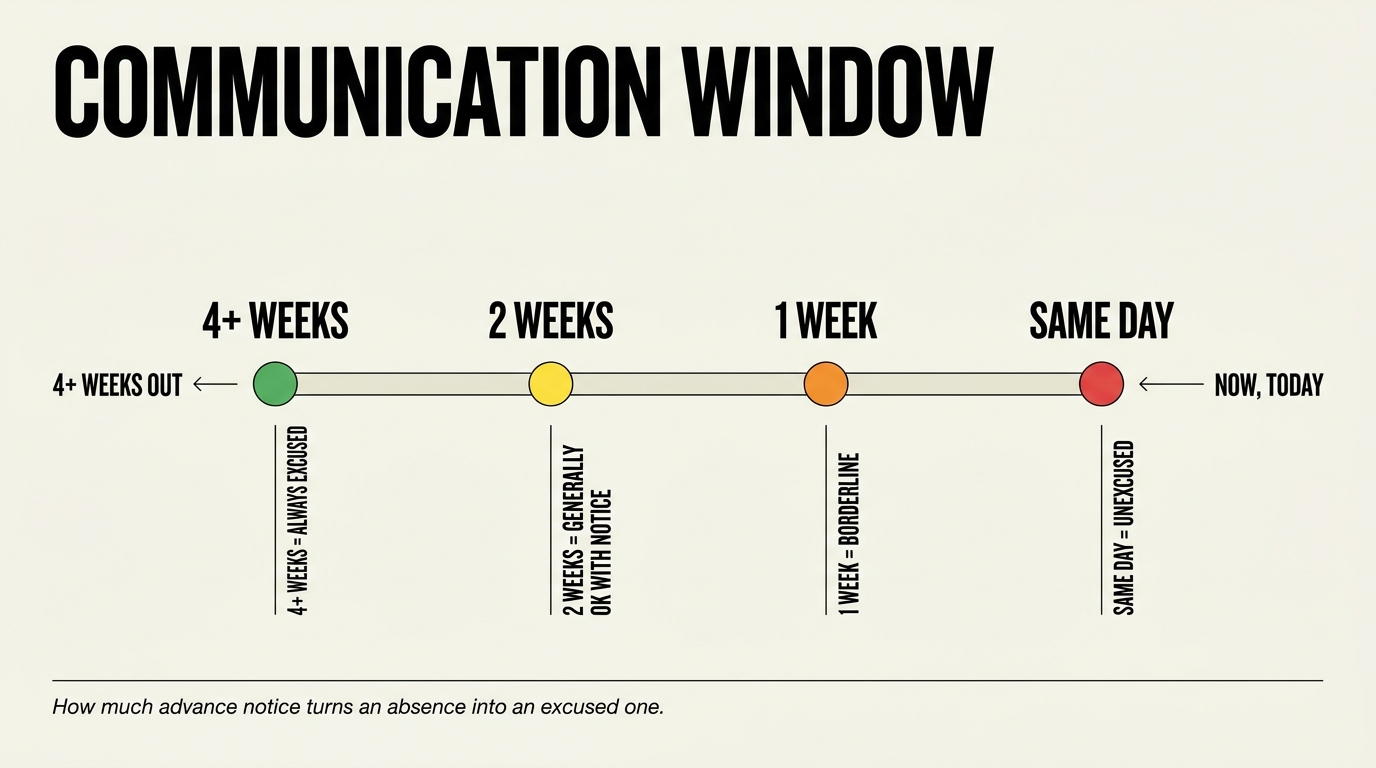
- Advance Notice: e.g., "Minimum 4 weeks notice of conflicts"
- Load-in Time: When to arrive before show
Other Commitments:
- Band meetings: Frequency and expectations
- Recording sessions: Expectations
- Promotional activities: What's required
- Social media participation: Expectations
2. Excused vs. Unexcused Absences
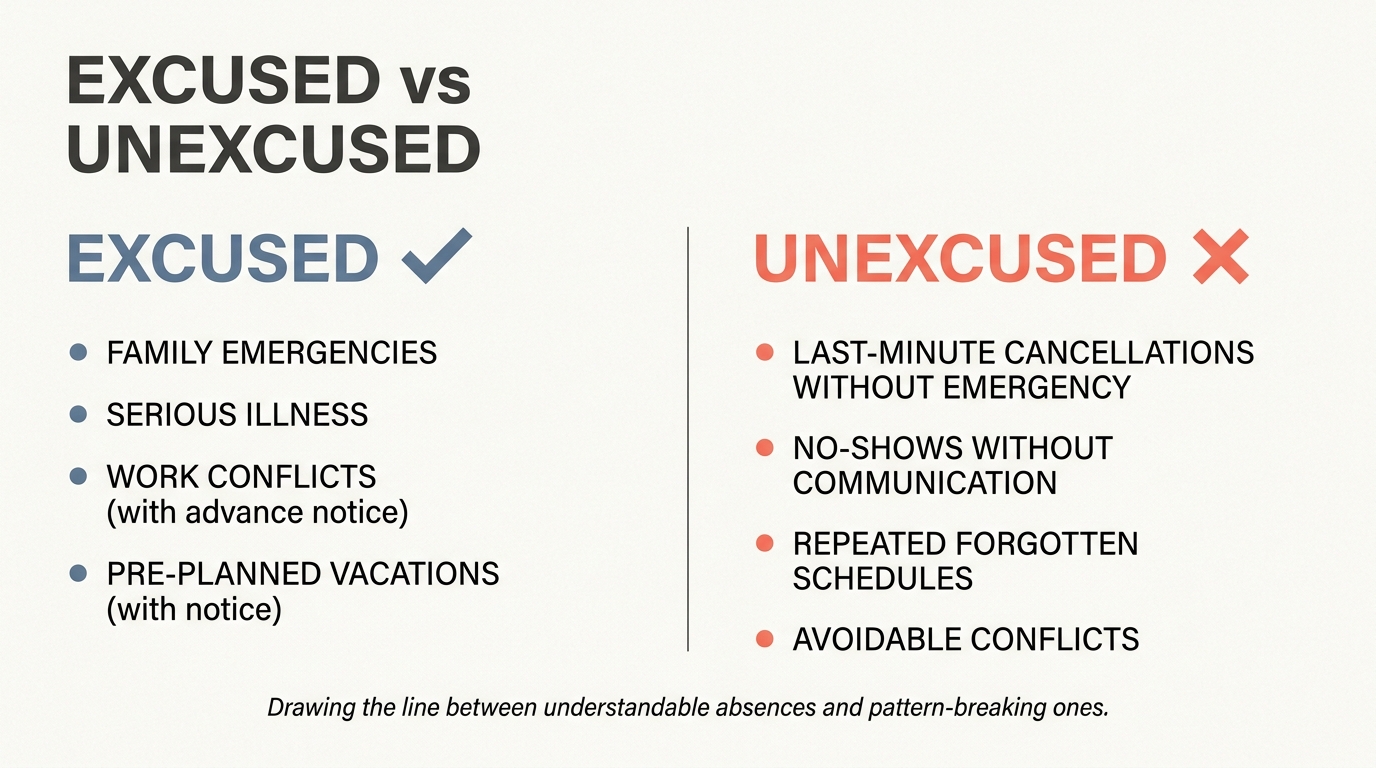
Excused Absences (with advance notice):
- Family emergencies
- Serious illness
- Work conflicts (with X weeks notice)
- Pre-planned vacations (with X weeks notice)
- Other: _______________
Unexcused Absences:
- Last-minute cancellations without emergency
- No-shows without communication
- Repeated "forgot" or scheduling conflicts
- Conflicts that could have been avoided
3. Communication Requirements
How to Report Absences:
- Method: Text/Email/Band app/etc.
- Who to notify: Band leader/Group chat/etc.
- Advance notice required: Timeframe
What to Include:
- Reason for absence
- Whether you'll be at next rehearsal
- Any materials/parts that need to be covered
Example Message: "Hey everyone, I have a work conflict next Thursday and won't be able to make rehearsal. I'll be back the following week. I've been working on song and will send a video of my parts."
4. Lateness Policy
Expectations:
- Arrive by: e.g., "Start time, ready to play"
- Setup time: e.g., "Arrive 15 minutes early to set up"
- Acceptable lateness: e.g., "Up to 10 minutes with text"
Chronic Lateness:
- Defined as: e.g., "More than 15 minutes late 3+ times in 2 months"
- Consequences: See Section 6
5. Attendance Tracking
How We Track:
- Shared spreadsheet
- Band management app
- Simple group record
- Other: _______________
What We Track:
- Attendance (present/absent/late)
- Reason for absence
- Advance notice given (yes/no)
- Pattern notes
6. Consequences for Poor Attendance
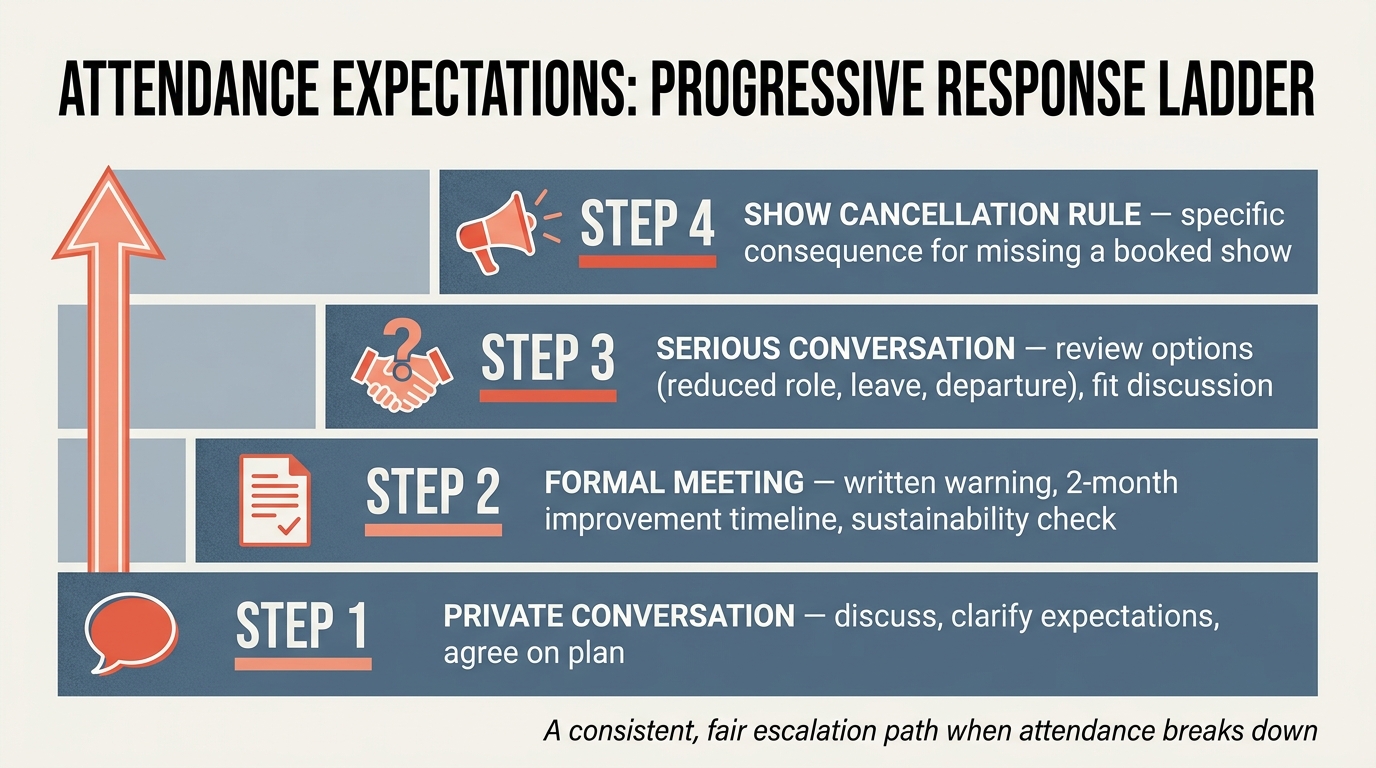
Progressive Response:
First Issue (1-2 unexcused absences or chronic lateness):
- Private conversation with band leader
- Discuss what's going on
- Clarify expectations
- Agree on improvement plan
Second Issue (3-4 unexcused absences):
- Formal band meeting
- Written warning
- Specific improvement timeline (e.g., 2 months)
- Discussion of whether commitment level is sustainable
Third Issue (5+ unexcused absences or no improvement):
- Serious conversation about fit
- Options:
- Reduced role (if applicable)
- Temporary leave
- Departure from band
- Other: _______________
Show Cancellations:
- Missing a booked show without emergency: Specific consequence
- Last-minute show cancellation: Specific consequence
7. Life Happens Clause
We recognize that life circumstances change. If you're going through a period where you can't meet these expectations:
- Communicate early and honestly
- Discuss options:
- Temporary reduced schedule
- Short-term substitute
- Leave of absence
- Transition out
- Make a plan together
Being honest about changing circumstances is respected. Continuing to commit when you can't follow through is not.
8. Band Responsibilities
The band commits to:
- Scheduling rehearsals X weeks in advance
- Respecting members' time by starting/ending on time
- Making rehearsals productive and worthwhile
- Being flexible when genuine emergencies arise
- Communicating schedule changes ASAP
9. Review and Updates
This policy will be reviewed: Annually/As needed/etc.
Signatures:
_________________________ Date: _______ Member Name
_________________________ Date: _______ Member Name
_________________________ Date: _______ Member Name
_________________________ Date: _______ Member Name
Sample Policies by Band Type
Hobby Band (Low Commitment)
Rehearsals: Twice monthly, flexible scheduling Expected Attendance: 75% of rehearsals Shows: Discuss each opportunity, no obligation Philosophy: "Life comes first, band is for fun"
Serious Hobby Band (Medium Commitment)
Rehearsals: Weekly, consistent schedule Expected Attendance: 90% of rehearsals with advance notice for absences Shows: Committed to booked shows, 4-week notice for conflicts Philosophy: "We're serious about our music but understand life happens"
Semi-Professional Band (High Commitment)
Rehearsals: Weekly plus additional sessions as needed Expected Attendance: 95% of rehearsals, all shows mandatory Shows: All booked shows are non-negotiable except emergencies Philosophy: "This is a professional commitment with some flexibility"
Professional/Touring Band (Very High Commitment)
Rehearsals: As scheduled, often intensive periods Expected Attendance: 100% of scheduled commitments Shows: All shows mandatory, conflicts must be cleared months in advance Philosophy: "This is our job, we depend on each other"
Attendance Tracking Spreadsheet
Simple Tracking Template
| Date | Member 1 | Member 2 | Member 3 | Member 4 | Notes |
|---|---|---|---|---|---|
| 1/7 | ✓ | ✓ | A (work) | ✓ | |
| 1/14 | ✓ | L (15m) | ✓ | ✓ | |
| 1/21 | ✓ | ✓ | ✓ | A (sick) |
Key:
- ✓ = Present
- A = Absent (reason)
- L = Late (how late)
- E = Excused absence
- U = Unexcused absence
Detailed Tracking Template
Member: _______________ Tracking Period: _______________
| Date | Status | Advance Notice? | Reason | Notes |
|---|---|---|---|---|
Summary:
- Total rehearsals: _____
- Attended: _____
- Excused absences: _____
- Unexcused absences: _____
- Times late: _____
- Attendance rate: _____%
Conversation Guide for Addressing Attendance Issues
First Conversation (Informal)
Setting: Private, casual Tone: Curious and supportive
Opening: "Hey, I wanted to check in. I've noticed you've missed X rehearsals in the last timeframe. Is everything okay?"
Listen for:
- What's actually going on
- Whether it's temporary or ongoing
- Their level of commitment
- Whether they're aware of the pattern
Possible Responses:
If temporary issue: "I appreciate you letting me know. How long do you think this will last? What can we do to support you through this?"
If ongoing challenge: "It sounds like your schedule has changed. Let's talk about whether our current rehearsal schedule still works for you."
If commitment question: "I'm hearing that maybe your priorities have shifted. That's totally okay, but let's be honest about whether this is still the right fit."
Second Conversation (Formal)
Setting: Scheduled meeting Tone: Direct but respectful
Opening: "We talked about attendance timeframe ago, but the pattern has continued. We need to address this more formally."
Key Points:
- State the facts: "X absences in timeframe"
- Impact on band: "This makes it hard to specific impacts"
- Expectations: "We need specific requirement"
- Timeline: "We need to see improvement over the next timeframe"
- Consequences: "If this continues, we'll need to specific consequence"
Questions to Ask:
- "Can you commit to this improvement?"
- "What needs to change for you to meet these expectations?"
- "Is this still the right fit for you?"
Third Conversation (Decision Time)
Setting: Band meeting or private conversation Tone: Firm but compassionate
Opening: "We've had two conversations about attendance, and unfortunately, things haven't improved. We need to make a decision about how to move forward."
Options to Discuss:
- Departure: "It seems like this isn't the right fit right now"
- Reduced role: "What if you moved to backup/part-time status?"
- Leave of absence: "Would taking a break and rejoining later make sense?"
Closing: "I appreciate everything you've contributed. This is about finding the right fit for everyone."
Progressive Consequence Framework
Level 1: Awareness
Trigger: 1-2 unexcused absences or late arrivals Response: Informal check-in conversation Goal: Understand what's happening, clarify expectations Documentation: Mental note or simple record
Level 2: Concern
Trigger: 3-4 unexcused absences or continued lateness Response: Formal conversation with specific expectations Goal: Clear improvement plan with timeline Documentation: Written summary of conversation and expectations
Level 3: Action Required
Trigger: 5+ unexcused absences or no improvement after Level 2 Response: Band meeting to discuss options Goal: Make decision about continued membership Documentation: Written record of decision and next steps
Special Case: Show Cancellation
Trigger: Missing a booked show without emergency Response: Immediate serious conversation Potential Consequences:
- Financial responsibility for lost income
- Immediate departure from band
- Reduced role going forward Note: This is typically a Level 3 issue regardless of prior attendance
Tips for Success
For Band Leaders
- Set expectations early - Discuss attendance in first conversation with new members
- Model the behavior - Be reliable yourself
- Track consistently - Don't rely on memory
- Address issues early - Don't let resentment build
- Be fair but firm - Apply policies consistently
- Communicate clearly - No surprises
- Stay solution-focused - Help people succeed
For All Members
- Know the expectations - Ask if unclear
- Communicate proactively - Don't wait until last minute
- Be honest - If you can't commit, say so
- Respect others' time - They're making the commitment too
- Track your own attendance - Be self-aware
- Speak up if expectations are unrealistic - Better to adjust than fail
For the Whole Band
- Review regularly - Are expectations still right?
- Celebrate reliability - Acknowledge those who show up
- Make it worth it - Productive rehearsals justify the commitment
- Be flexible when appropriate - Rigid policies can backfire
- Support each other - Life happens to everyone
Common Scenarios
Scenario 1: New Job with Unpredictable Schedule
Member: "I just started a new job and my schedule is all over the place for the next few months."
Response: "Thanks for letting us know. Let's figure out what works. Can you commit to reduced schedule during this transition? Let's check in again in timeframe to see if things have stabilized."
Scenario 2: Chronic "Forgot"
Member: "Sorry, I totally forgot about rehearsal again."
Response: "This is the third time. What's going on? Do you need help with reminders, or is something else happening? We need you to be reliable."
Scenario 3: Family Emergency
Member: "My dad is in the hospital. I don't know when I'll be back."
Response: "I'm so sorry. Family comes first. Take the time you need. Let us know when you're ready to talk about coming back. We're here for you."
Scenario 4: Vacation Conflict with Show
Member: "I just realized I booked a vacation during our show in June."
Response: "When did you book it? If before show was booked: We'll figure it out. If after: This is a problem. We committed to this show. What can we do to make this work?"
Key Takeaways
- Clear expectations prevent conflicts - Everyone knows what's expected
- Communication is key - Talk early and often
- Track objectively - Don't rely on feelings or memory
- Address issues early - Small problems become big ones
- Be fair and consistent - Apply policies to everyone
- Life happens - Build in flexibility for genuine issues
- Know your dealbreakers - Some things are non-negotiable
- Review regularly - Expectations should match current reality
Conclusion
Attendance expectations aren't about being rigid or unreasonable. They're about creating a framework where everyone can succeed, where reliable members feel respected, and where issues can be addressed fairly before they become crises.
The best attendance policy is one that:
- Matches your band's actual goals and commitment level
- Is communicated clearly from the start
- Is applied fairly and consistently
- Includes flexibility for genuine life circumstances
- Is reviewed and updated as the band evolves
Use this template as a starting point, customize it for your band, and most importantly, actually use it. Having a policy that sits in a drawer helps no one. Make it a living document that guides your band's culture and accountability.
Subscribe to our newsletter
Get the latest news and updates.
No spam. Unsubscribe anytime.


Bandmate® is the complete platform for musicians, bands, and venues to connect, collaborate, and grow. Find bandmates, discover venues, and build your music career with tools designed by musicians, for musicians.